Showing posts with label photos. Show all posts

Monday, 3 November 2014

Norfolk part 3- sketching at Titchwell


 Here we go! In the third and last part of my series of posts about Norfolk, I return to Titchwell and bring my sketchbook too. Btw the above photograph was taken at Titchwell beach. In contrast to Cley's shingle beach it has lovely sand. But the weather was pretty blowy and wild that day so not many sunbathers!

Monday, 14 April 2014

Eggs, Baby Birds and Books

The first baby birds are in our garden! Last Tuesday I was enjoying the newly light evenings and watching the garden when I spotted some wing fluttering and feeding action in one of the trees. A quick look through binoculars showed that this wasn't a male courtship feeding a female, as the bird being fed was reddish-brown and appeared very round because of its fluffed up feathers and almost complete lack of tail. It was a baby, the first one of any species I've seen this year! (The day after I first spotted the Blackbirds, however, I saw the first tiny Mallard duckings in St James's Park!) A closer look showed it had a visible gape, which is the wide, colourful mouth-edge baby birds have in the nest to make their beaks super visible to the parents birds when they come with food. You can see these on all kinds of songbirds.


On a closer look, there were two babies, being attended by the male. One was hunched up and still, and I doubt I would have spotted it if I hadn't seen the male arrive initially, which really shows how quietness and stillness can hide baby birds when their parents are away finding food. The other baby, however, was quite active and was fly-jumping around the tree like anything, it's tiny tail cocked, looking like a giant wren! Interestingly the male visited and fed the still baby three times while I was watching, with the active baby not being fed once, even though at one point it hopped right over to where the male was feeding the first baby and sat there looking expectant. I don't know what's happening there, but I have to say the hopping chick seemed very energetic and healthy so I doubt any long term neglect is happening. Blackbirds are such efficient breeders, they tend to be the first baby birds you see in the spring and starting early means they can often churn out 3 broods in a season, and therefore don't go in for massive clutches, so long-term favouritism in their broods doesn't make sense for them.

**********************************

The day after seeing the young Blackbirds, I found these in our drive:


Of course I immediately jumped to the conclusion that they must be the Blackbirds eggshells! But after borrowing my Mum's guide to bird eggs and nests, I found that Blackbird eggs are extremely speckley, and these very pale blue, almost speckle-free eggshells are actually a much better fit for a Starling. This makes sense as Starlings nested under our neighbour's roof tiles last year and we've been seeing them there again. These were actually found surprisingly close to where the nest is, as birds usually take the shells a little distance away to drop them so they don't draw predators to the nest, but at least they weren't directly under it I suppose! I guess here is a possibility it's from Starlings at a completely different site.


This seems a good time to point out the difference between these eggs and the one I found back in January that I guessed had been predated by a corvid. That one had an intact shell except for a big hole in its side. These ones, however, have been cut neatly around the middle! Here's another photo so you can better see what I mean:


Look at those careful, regular cuts! A tiny bird has cut those using its egg tooth while still inside. Regular halves are a sure sign that you are looking at naturally hatched eggshells.

**********************************

Forgive the absence of posts recently, I've been working on a costume for an upcoming convention I'm going to! Cosplay and birds are my two passions. :D And I'm also in the middle of a post about a Black-headed Gull colony I sketched at about a month ago, but sketchbook posts take forever to put together and I wanted to talk about baby birds! Have you seen any baby birds yet? If so, tell me all about it!


Now, earlier in the post I mentioned that my Mum has a guide to birds eggs and nests. It's worth mentioning that (as far as I know) you cannot buy these new, because egg collecting has been such a huge thing in the past, it is all kinds of illegal now, but it still happens and the last thing anyone wants to do is encourage it. This is really important, but it can be annoying if you find an eggshell and can't find a book to ID it. My Mum's book was published in the 70s (and was actually published in Czechoslovakia, which I only realised recently and which explains some of the birds included that had puzzled me in the past, like Short-Toed Treecreeper, Crested Lark and Great Reed Warbler, none of which breed in Britain!), and for my last birthday my sister gave me an egg book of my own, which she had found second hand. That, I think, is the best thing to do if you want a book about bird eggs- check second hand shops and stalls, and hopefully you will come across one. Mine is not quite as useful as my Mum's as it limits itself to 'woodland and hill birds', which doesn't appear to include Blackbird or Starling, but it has all the other thrushes, the tits, corvids, pigeons, farmland birds, game birds etc etc so that's all very useful. :) It was also published in Czechoslovakia in the 70s, though the author and illustrator are not the same as my Mum's, which was interesting to spot- maybe loads of bird egg books were coming out of Eastern Europe at the time and being translated? The range of birds is even wider and includes Roller, Nutcracker, Griffin Vulture, Hazel Grouse, Eagle Owl and all that cool stuff! My sister was really on the ball when she bought me that. :D


By the way, though I am a feather collector and have a growing collection of bones (and one deer tail), I wouldn't recommend anyone to collect eggshells because egg collecting is still just too close to home, at least in the UK. Hatched eggshells are very different from ones blown by a collector, but still, I prefer not to go there at all. The ones in my photo were put back outside once I'd photographed them. Bird eggs are beautiful, but they only belong in the wild, and in the UK every single one of them, no matter how common the bird, is protected to the full extent of the law from human intervention. Nests and eggs are more precious than gold.

Thursday, 13 March 2014

Guessing at Fungi, and a Sly Visitor!

If you've been reading my blog in the past few months you will know that I love fungi, but it's really a very recent thing that was kickstarted last autumn, when I was looking for birds (unsuccessfully) in a local wood, and suddenly noticed I was surrounded by autumn fungi, of all shapes and sizes. Then it turned into an obsession when I was in a German wood and found fungi in red, yellow, green and purple, and all kinds of shapes and textures. From then on, I've been noticing fungi everywhere.


I can't remember why I never noticed fungi before this autumn, as I was always out birdwatching before that in places where fungi might be found. I think it was something to do with an idea I had about most fungi being brown and white mushrooms that all looked the same and weren't very interesting. I knew there were more different shapes and colours and textures, but I thought you had to be an expert to find those ones, and you'd only get to that point after getting really good at looking at the brown mushrooms. However, I now realise this is absolutely not true- once you begin looking out for fungi you will start to realise that some of the commonest species of fungi are some of the most brightly coloured, strangest in shape, and weirdest in texture! I'm going to go on to show you some examples that I found in the past couple of months at my local patch during my weekly bird-counting visits- despite the bright colours of some of it, I might have overlooked if I hadn't had my eyes open for fungi.


First, a quick note: fungi is awesome to look at, but even species that look really distinctive can be strangely hard to identify. I found this out with my Meadow Coral/Yellow Stagshorn confusion in the Germany post I linked above, and from some correspondence I had with the excellent Mark Baldwin at Wildlife Online (http://www.wildlifeonline.me.uk/) I learned that photographing fungi where it grows may not be enough to always be sure of a positive ID- you may need to photograph the gill structure as well, or cut it in half to look at the structure inside, or for some of the 'brown mushrooms' I mention above, you might even need to taste the fungus's secretion! (Note: do NOT do this unless you are an expert!!! I certainly won't be trying it for a while!) The identification book for fungi that I use (which Mark also recommends), is Mushrooms by Roger Phillips, which I have on long-term loan from my dad, but I really must get my own copy ^^- this book includes how common a fungus is which is really useful (and also how poisonous/good to eat a fungus is, which is just interesting!). To back this up, when I think I've IDed something I use the Hampshire Fungus Recording Group website that I mention at the end of this post, and if there's not many records of it I reconsider the plausibility of my ID. I may also do a google image search on a species I think I've found, especially if it looked close but was a slightly different colour or shape than in the picture in the book, as fungi are widely variable in colour and shape (some with age, some...just to be annoying, I think XD) and an image search should show you several variations of the same species.


Now: on to the fungi!


I think these interesting little things are most likely to be Common Jellyspot, even though most of the pictures I saw of Jellyspot were more orange than these various shades of pink and maroon! I love the huge variety of shapes, sizes and textures that were all on the same log. The incredible smoothness, curvyness and shininess looks like some sort of modern art. Looking back at these photos now, I kind of wish I'd poked them with a stick to see if they were as squashy as they look! In the 4th photo down is what looks like one that's been squashed, so maybe they are.


These are both the same one- you can see in the top one how it seems to melt into the tree, and in the second one how high the dome is. I love this one because of how wet and jelly-like it looks, as if it's sort of melted down over the bark! Unlike the Jellyspot (and most other fungi I seem to see), this one was on its own. This was hard to ID but I think it might be White Milking Bonnet? Heeding Mark's advice about the gill structure, and also because I wanted to see what the stem was like under the cap, I took the following photo:

I had to make it bigger than the others as it's one of my favourite photos I've ever taken! :D

Even though this photo came out really nicely, I'm not experienced enough to actually use the gill structure to verify ID yet. I think the White Milking Bonnet is a subspecies of Milking Bonnet, and there aren't as many records of White Milking Bonnet in Hampshire as there are Milking Bonnet, but it's tricky with subspecies. This was a really hard one to get even a tentative ID on so if anyone knows about Milking Bonnet-type fungi or has another ID suggestion for my melting white mushroom, let me know! :)


This little bright one was a relatively easy; it's a Yellow Brain fungus! I couldn't have thought of a better name myself. Again, these are photos of the same one from different angles.


This one was an odd one. It looks quite like the Jelly Spot without any of the colour, but I found a photo of a fungus that looked like it in the suggested images while looking at google search results for the Yellow Brain- clicking into it showed it was called the Crystal Brain. Despite the name, as you can see it's not really that similar looking to the Yellow Brain, and the Latin names (Tremella mesenterica and Myxarium nucleatum) suggest they are not closely related at all. (Even fungi that do look alike aren't necessarily related, of course!) Crystal was the closest ID I could find for the fungi in the photo, but weirdly Crystal Brain wasn't in Roger Phillips' fungi guide at all, not even under the Latin name. But when I searched the name in the Hampshire fungi site, there were many records. Does anyone know why it might not have been in the book? Very odd, and it's a good thing the name is similar to the Yellow Brain or I might never have even had an idea what it might be!

********************************************************

The more interested I get in fungi, the more I see it everywhere! And to an extent, the same thing is happening with signs of mammals. As I wrote about in this post, I've been keeping notes about signs of mammals I see for the National Mammal Database, and my local patch is no exception. Warning in case you're eating dinner: poo pictures to follow!


Up at the top of my patch there's a railway line surrounded by scrubby vegetation, and back in January I detected a sly visitor up there! Unlike most mammals, you can sometimes detect this one with your sense of smell. Walking along the field margin next to the railway line, I smelled a distinctive, spicy, peppery odour that can only mean one animal- a fox! And aside from the smell, there were various visual signs.


 My local patch is very popular with dog walkers, and unfortunately a large number of them don't clean up their dog mess, so dog would be the main confusion species for these droppings. However as you can see from the closeup, there are feathers and what looks like crunched up bones in this dropping, not something you'd generally find in the poo of a dog fed on dog food. Plus when I was taking this photo, I noticed that the smell was...actually not as bad as you'd expect from a dog! While dog poo really stinks (and it makes my patch a bit unpleasant on a hot summers day, I can tell you!) this poo merely smelled like more of the fox smell, which wasn't unbearably unpleasant. I haven't included badger as a confusion species for this despite the size being similar, because I've seen no evidence of badgers at my patch or in the area at all, and don't think it's likely. But as I mentioned in the post I linked at the start of this section, badger poo doesn't really seem to have a smell.


I also found these nearby: 


Considering that the fox droppings had feathers in them, and these Woodpigeon feathers have been broken off by the shaft, I suspect that someone caught a pigeon and ate at least some of it near here! A sign you can use to tell if a mammal removed the feathers from a kill rather than a bird of prey is if the feathers are bedraggled, which can be due to the saliva of the animal and the fact that they sometimes chew the feathers. However in this case I think they're bedraggled because of the rain. The feathers in fox poo show a much more likely connection.


And finally, I found what looked like trails a fox-sized animal would make while pushing through the undergrowth: 


I was glad to find so many signs of my sly visitor! I don't know if any foxes have a territory nearby, and I've never seen or heard one in the area near my patch (it's near the suburban neighbourhood where I live, and I've never had any reason to believe there are urban foxes about), so it's possible this fox was just passing through. I did smell the foxy odour on a couple more visits since this, but never found so many clear signs again. This was all found a few months ago, I wonder where the fox is now?

********************************************************

It's funny- the more I look for different types of nature, the more I realise the value of educated guessing. You may not know 100% what you're looking at all the time, but you can get better at guessing, while waiting until you know more, or perhaps meet someone who knows more who can help you. For example, when I first was contacted by Mark Baldwin at Wildlife Online (linked at the top of this post) he verified some speculation I'd been mulling over in my Badger Mysteries post about whether badgers ever kill pheasants and other gamebirds. Mark showed me research that says- they do! It was brilliant to find out for sure. :) Thanks Mark, and as I always say, if you can give me the answers to any of my questions or you want to correct me on something, then I would absolutely love to hear from you!


And as the Spring rolls in, while you're keeping your eyes on the trees and your ears open for birdsong, don't forget to look down to the ground and keep your nose open too! ;)

Wednesday, 19 February 2014

Amazing Lichen

...Once again, I keep meaning to post more often, and that fungi post is still waiting for me to get the book out and ID them! Plus a lot of stuff has been going on and I've started another new job (last time it was a Christmas job, but hopefully this one will be long term!). But for now, let me share with you an amazing thing I saw a couple of weeks ago.


I went to one of the New Forest coniferous/deciduous enclosures in the hope of finding Siskins and Bramblings, but had no luck, so I'd decided to go back and move on to Keyhaven when I noticed a tree stump that was covered in lichen.


I went in closer for a look, and was amazed by the diversity of structures of lichen on this one stump. And yet I really think they were all the same species, because there were still similarities despite the different shapes.


A large amount of the stump was covered in blunt, branched spikes like these ones:


On some, the branches ended in rounded, shallow cups.


The long red things are old pine needles in case you were wondering!


And on some of the stalks, the ends were larger and flatter, looking a little like water-lily leaves!


I didn't really notice the tiny white dots while I was taking this photo, but now I wonder if those are the beginnings of new stems?


But there was something even more surprising. Look at this photo:


Yep, it's quite distinctive- there's a shiny red globule on the end of one of the stems! What's more, to the left of it you can just see another one starting to appear. I had never seen anything like it. What on earth is it? It couldn't possibly be a flower, could it?


It wasn't the only one either: here's but one of the photos I took of another one that was helpfully isolated on its own so I could get a clear shot:


I've seen some weird, colourful fungi, in a variety of textures, but all the lichen I'd ever seen before had been crusty and rough-looking, so this was the first time I'd ever seen smoothness on lichen. Maybe that's why I found this so fascinating, as well as the fact that it seemed so different in colour and texture from the rest of the lichen growths, very like a colourful flower growing from a green stem, only lichens aren't plants and as far as I know don't need to be pollinated, so what is the purpose of the red globules? If anyone knows, or can tell me the proper name for the globules, please please let me know! Part of me is happy reveling in how weird they are, but the rest of me would love to know what's actually going on here. ^^


But that wasn't all! There were multi-growth globules too! 


They look so shiny! They also look like they'd be wet and squashy, but I'm pretty sure I tested this out by poking them with something and they actually were quite solid. Whatever they're for, looking shiny must be useful for that in some way!


While trying to identify this lichen, I found this helpful picture guide where you can choose what category you think your lichen best fits in. I decided mine was a Shrubby lichen, and that led me to three species that have red growths: Cladonia polydactyla, Cladonia coccifera and Cladonia bellidiflora. (I think all the species in that section are in the Cladonia family.) Coccifera and bellidiflora had different shapes and textures of branch in the photos I saw, so I'm going to tentatively identify the species I found as Cladonia polydactyla, though I could always be wrong so please do correct me if so! Interesting, the photo the site had of Cladonia polydactyla had red growths on practically every stalk, and the growths also looked less shiny, so I wonder if the one I found was only just starting to grow its red globules, and the ones it did have looked shiny because they were very new, and soon, perhaps by now as I'm writing this, the red globules would be absolutely everywhere? I wish I could see the stump again right now!


As you can probably tell, I not only know very little about lichens but have never really considered knowing more before I found this lichen that interested me so much. I probably should read up more on lichens and find out what the red things are and why they are all coming out now. If I do, I'll be sure to write another post, but for now I'll certainly be keeping my eyes open for lichen like never before!

Tuesday, 12 November 2013

GA part 2: Fabulous Fungi


Yesterday, I wrote about some of the birds I saw in Stadtwald Lemgo. There was also some amazing fungi in the wood, particularly in the coniferous parts, and unlike last time I was looking at fungi I had my camera on me, so let’s take a look!


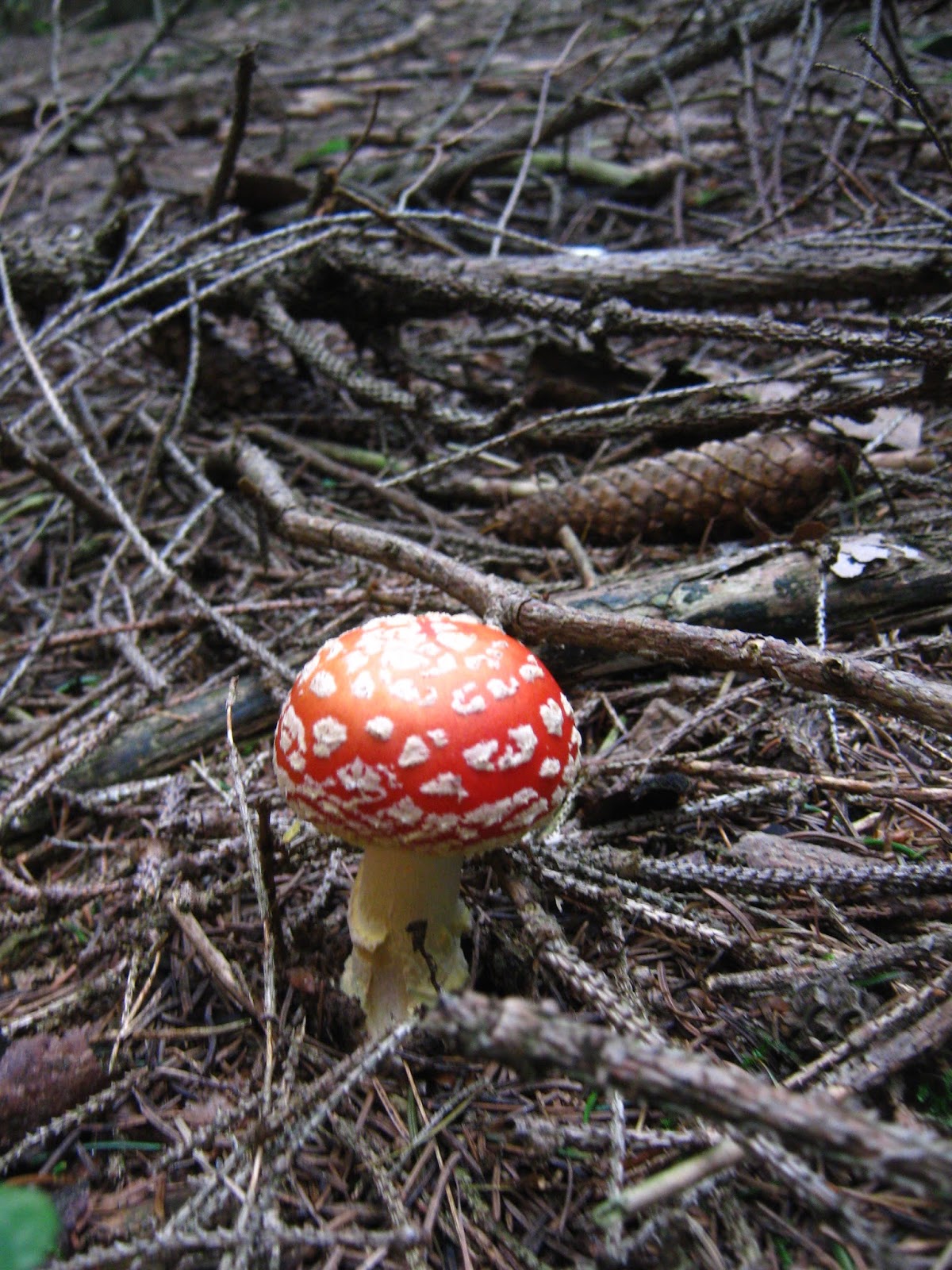
These are all Fly Agaric, the classic ‘toadstool’ fungi, which I’ve seen in the UK before but never so many at once- in some parts of the wood they were very numerous. There were lots of different sizes and levels of spottiness.


This is another one I’ve seen before, the Shaggy Inkcap, in two levels of size and inkiness! These were found outside the wood, on the grassy verge of the road leading to it.


Now this is a new one for me: it’s another agaric, this time Verdigris Agaric. Its striking green colour caught my eye almost as strongly as the bright red Fly Agaric, and like them it has white spots. I think this one looks a little like those colourful macaroons you can get! Only poisonous. ^^


This one also caught my eye because of its unusual colour;
I think it’s Russula fragilis which unfortunately doesn’t seem to have a common name Actually it does! It's Fragile Russula, which I found out from scrolling down on this factsheet about the Charcoal Burner fungus. So its common name is just a translation of the Latin name but that's fine by me! (Though according to the factsheet, both the Charcoal Burner and the Fragile Russula have variable colours so it could be hard to tell the difference by colour, and my photo could be on either. As the Charcoal Burner is also called Parrot Russula so I'll tag this post Russula for now.)


This fantastic thing was the brightest of all! It reminded me of a piece of coral rather than something you’d find in a wood. It’s actually caused a bit of an ID conundrum though, I now think it’s Yellow Stagshorn but initially thought it was Meadow Coral. Meadow Coral can be found in woods, but Yellow Stagshorn attaches itself to conifer roots, and it was found in a conifer forest. Was it attached to a root? I couldn’t say and there’s no way I can go and check now, I wish I’d taken more photos of more of the different specimens of this fungi that were around! I’d never seen anything like it and had the sort of idea that it would be an easy ID, but actually there are many coral-looking fungi, and both the Meadow Coral and the Yellow Stagshorn are common! Must keep an eye out for coral fungi in the UK. Anyway, if you can solve this ID mystery please do drop me a comment and let me know! I would be so grateful! :)

Update (22/11/13): Was doing some research on fungi today and found this photo of the Meadow Coral, which doesn't look anything like my photo, so I think I have Yellow Stagshorn here.


And finally, I almost missed these tiny little things that were next to the path leading out of the wood. I’m pretty sure they are Field Bird’s Nest, which is such a brilliant name- they even look like they have little eggs inside them!

That was all the fungi I photographed, but there was something else just as brightly coloured: take a look at this little guy!


I say little, but as slugs go he’s enormous. And WHAT a colour! I’ve never seen one like this before. I’ve done a little research and I think he might be a Red Slug, though I’m happy to be corrected. I wish I had a book on slug species! I saw one in the UK recently with some gorgeous patterning which I would have loved to identify.

Tomorrow: the birds I saw on the ferry crossing!

Monday, 11 November 2013

German Adventures part 1: What's in a name?


My sister is doing French and German at university and she's currently living in Lemgo, Germany, for her year abroad. Last month my parents and I went out there to visit her. Lemgo is in north-west Germany, and my dad doesn't fly so to get there we took the ferry from Dover to Calais, then drove through Belgium and the Netherlands to get into Germany. Five countries in two days! It was exhausting.

Of course, when my sister was settled in at Lemgo (she lives in a granny flat-type thing under a house), I had one question- 'what's the wildlife like there!' She couldn't tell me much, but from the minute I arrived I had my binoculars out, and practically never put them away. I was determined to find out everything I could about the wildlife of Lemgo, because I don't go to other countries very often and I wanted to make the absolute most of the chance to see wildlife outside the UK. On the day we arrived my sister had some exciting news: she had seen a Red Squirrel from her garden window that morning! On the second day of our stay we all saw one: a dark red, beautiful, tufty creature with a lovely thick tail, perched in the garden apple tree and then running off over the bushes with a piece of apple in its mouth. Germany never allowed Grey Squirrels to become introduced (I hear the closest ones on the Continent are in Italy), and it was wonderful to find out that the Grey Squirrel problem is not all over Europe. For some reason it hadn’t occurred to me that it wouldn’t be. Though Germany does have Racoons- descendants of escaped pets, apparently!

The weather confusingly went from being what my sister called ‘coat and gloves weather’ before we came, to a humid, sweaty mildness, though the leaves were turning autumn shades beautifully all over Lemgo. I couldn’t resist starting a small garden list for the view out of my sister’s window, after 15 minutes of watching produced Blue Tits, Blackbirds eating elder berries, a gorgeous male Bullfinch, a Great Spotted Woodpecker and a House Sparrow in quick succession. (The House Sparrow, a male with only a tiny black bib, appeared to be picking up nesting material- perhaps one of this year’s birds confused by the warm weather?)

The view over Lemgo from the park. Look at those autumn shades!

But things got even better! 5 minutes away from my sister’s place is a large, mixed deciduous and coniferous wood, and with the leaves on the deciduous trees changing bright colours, there couldn’t have been a better time of year to visit. Before we’d even visited the wood I got a taste of the wildlife there. While we were waiting for a bus near my sister’s home, I looked over towards the forest and saw a Buzzard circling over the trees, along with another soaring bird of similar size but which wasn’t holding its wings in the typical Buzzard shallow ‘v’. Looking through my binoculars I saw it was all white underneath, which most Buzzards aren’t, and had a longer tail which it did not spread in flight. It was, in fact, my second Goshawk ever! Unlike in the UK Goshawks are not rare in Germany at all; it has the highest number of breeding pairs in Europe apart from Russia, which is of course a lot bigger. Then later when I got the chance to visit the wood properly I happened to glance upwards, and there gliding above the treetops was another Goshawk, this time being mobbed by another bird, a Sparrowhawk that looked absolutely tiny in comparison. I love seeing mobbing situations that involve birds of prey mobbing other birds of prey, and this also gave me a great chance to see the size difference between Goshawks and Sparrowhawks, two species that are often confused in the UK but that there is no confusing when they are seen together!


I had heard that Goshawks were much commoner in Germany but seeing these two birds without any effort at all took a little getting used to, especially after all the multiple journeys and searching it took to see my first one in the UK. During the visit I was able to meet and chat to a German birdwatcher (my sister’s professor’s wife) who showed me all her bird books and we got talking about our favourite visitors to our gardens. She had seen Hawfinches in her garden! I told her about the Yellowhammers that visited our garden last winter, and the Sparrowhawk that had started to visit regularly (the male involved in last post’s clash of the titans, though he seems to have moved on at the time of writing), which I described as a hawk that is commonly seen in gardens. Using the book I was able to show her which one (the German for Sparrowhawk, awesomely, is Sperber), and she said ‘oh, I thought you meant Habicht’, which is Goshawk. Apparently Goshawks are seen in gardens, in Lemgo anyway! I think Habicht might translate as just ‘hawk’. I love finding out about different country’s names for birds. My favourite example of a different bird name was one of our hostess’s favourite garden visitors, the Wintergoldhänchen or Goldcrest, whose name translates as ‘winter gold chicken’. Firecrest, incidentally, is Sommergoldhänchen (summer gold chicken). The summer and winter parts make sense as in a lot of Germany Firecrests are summer visitors only, and while Goldcrests are found all year round, if it’s anything like Britain they are much more secretive in their breeding season, and a lot more visible in winter when the leaves are off the trees and they tag along with winter tit flocks. The part that really doesn’t make sense to me is the ‘chicken’ part. How can such a teeny bird be compared to a lumping great bird like a chicken? Very strange!


Stadtwald  Lemgo, or Lemgo town forest, with the evening light shining through the trees.

 It’s a good thing my sister isn’t that into wildlife as if she had been she wouldn’t have done any work due to spending too much time in those woods! I could have spent every daylight hour there, seeking out its feathered inhabitants. It was hard to find the birds in the deciduous parts as they were almost silent, but the coniferous parts were filled with little ‘see-see-see’ sounds. Being with family I often wasn’t able to take the time to wait for the birds to show themselves, but at one point I could hear flock calls above me and sat down to wait for a while. After a moment a small bird came into view, and I got an impression of a big, fluffy head, finely barred in white and black, before it disappeared again. I can’t be certain because I didn’t see it very well, but I think it was my first ever Crested Tit! Like the Goshawk, the Crested Tit in Germany has a much wider range than in the UK, where it is restricted to the Caledonian forests in Scotland. Speaking of different ranges, I later saw a Treecreeper...or it could have been a Short-toed Treecreeper, because their ranges overlap over that part of Germany, and they are practically impossible to tell apart by sight in the field. In some parts of Europe you can only find Short-toed’s, so it would be as easy there as it is in Britain, (where you can only find Treecreepers except for very rare vagrant Short-toed’s). So, my notebook just says Treecreeper for now! Maybe one day I will be able to distinguish them by call, if I somehow become well-versed in Continental birdwatching...


Tomorrow: some of the fungi I found in Stadtwald Lemgo!

Tuesday, 15 October 2013

Life and Death in Wales part 2- The Gannet


On the first day of our holiday in Aberdovey, we went to the neighbouring town of Tywyn where there’s a lovely beach.  I did what I normally do at the beach, which was have a nice swim in the sea and then do a bit of feather collecting on the shoreline before lazing around reading.  But this time I saw something I’d never seen before.  My brother told me there was a dead gull floating in on the tide, but on looking at it I saw it was a bigger bird altogether- a beautiful Gannet.


We waded out into the water and pulled it to the shore so we could have a proper look at it.  It was in beautiful condition, with no noticeable signs of injury.  Gannets have an impressive wingspan that can be almost two metres wide, so I tried to spread the wings to get the full effect, but it was hard to do, the wings so stiff with powerful tendons that I couldn’t open them to anywhere near the full gliding position. In my photo you can see the rows of wing feathers, and the way the white feathers are translucent where they lie over the dark feathers.  


Before I saw one this close I never realised adult Gannets have a dark area of feathers on their wings that is separate from the black tips; I think it's the Gannet's alula that is dark- the feathers at the bend of the wing on the leading edge that are used for steering- but I'm happy to be corrected as that's just guess.  From a distance you can't see that at all, so I was surprised.  You can see how powerful and strong the feathers are, and also that they're not as black as they look from a distance but are actually a very dark brown, and shiny.


Here you can see the blue area of skin around the eye, which is still present in its socket.  Because of this, I think the Gannet must have been dead only hours.  It's really sad to see one of these wonderful birds dead, but from its plumage you can tell the Gannet is at least five years old, as younger birds have dark spots in the white areas of their plumage- I've seen ones in various stages of sub-adult plumage, mostly from ferrys.  So this one at least had had a bit of a life!  You can also see the complicated pattern of plates that make up its beak.


Here are the strong, thin tail feathers, and the oddly shaped webbed feet and clawed toes.  There's a bit of damage to the feathers at the base of the tail, but I don't have any idea what could have killed this Gannet.

At Twywn beach in the summer you can see Gannets passing across the sea often, and it's always wonderful to watch them.  They are one of our biggest and most distinctive seabirds, and are more seafaring than gulls or terns.  When you go out into, say, the Channel, you'll stop seeing gulls and terns very quickly, but you'll see Gannets throughout the crossing.  I love their steady flight over the sea and their distinctive white wings with black tips, and the way they dive to fish.  It was sad to find this dead one but also a fascinating opportunity to look at one close up.