Showing posts with label Germany. Show all posts

Thursday, 14 November 2013

GA part 4: Simularities and Differences


Birdwatching in Germany, and in all the countries we traveled through to get there, is not so different from in the UK- after all, they are not that far apart. But I did see some similarities and differences, which I will now describe.


The same:

Buzzards and Red Kites- Just like at home, Buzzards were a common sight, soaring over the roadsides and perched on fences and trees, and Red Kites were a slightly less common but occasional sight.

Carrion Crows- Most of Europe has Hooded Crows (including northern Scotland and Ireland), but Lemgo had Carrion Crows like the rest of the UK, including the part where I live, does. I’d thought that Germany had Hooded Crows because I visited Berlin one winter several years ago and saw my first ever Hooded Crows, which seemed to be all over the city. But looking at distribution maps, Carrion Crows are found all year round in Germany and Hooded Crows are winter visitors. I never really thought of crows migrating, but there you go! So that was interesting.


There were less...

Large gulls- In the UK you always seem to see large gulls, like Herring and Lesser Black-backed, flying over roads or feeding on fields. Once we got away from Calais there just weren’t any more! It’s easy to forget sometimes that the UK both (a) is not very large, and (b) has a large amount of coastline compared with other countries. Black-headed Gulls were the only gulls seen on fields or following ploughs, but there didn’t seem to be quite as many. 

Collared Doves- I didn’t see a single one around Lemgo, not even in the suburban area where my sister lives, and the suburban areas are where you’ll normally see Collared Doves. Maybe the large amount of woodland nearby affected this?


There were more...

Kestrels- I really feel like it’s now hit home to me that Kestrels are declining in Britain, because my family quite often drives from the south to Newcastle and you see maybe one Kestrel in that entire 6 hour drive. The equivalent drive across the Continent had several Kestrels ever hour, it was really great and wonderful to see the ‘motorway falcon’ in numbers again, hovering by the roads.

Starlings- Flocks of Starlings were often seen flying over the road, more than you’ll see from a car in the UK, where it would probably be Woodpigeons you’ll see. That may just mean there are more Starlings near the roads though.


..And, as I’ve already written

Red Squirrels- None of these in my garden at home! *sobs* You don’t see ‘park’ squirrels in Germany, by which I mean those cheeky Grey Squirrels in urban parks that are very tame because people feed them from the hand, so you have to really catch your views of the Red Squirrels before they disappear, but it’s well worth it, especially for us sad Brits who miss our reds.

Goshawks- It was so weird to be in a place where these hawks that are so sought after in Britain are so common! I read an article ages ago that said you can even find them in the centre of Berlin, eating the Feral Pigeons. If I’d known about that on my trip you’d probably have had trouble getting me to stop sitting in parks looking at flocks of pigeons and hoping a Goshawk would come, and missing all the history and art and things. ^^


This last one isn’t a wildlife thing, but...

Small Ponies!- In the Netherlands, they really seem to go in for tiny ponies, and we saw several whole herds of them in fields and even in woods that we passed. I hesitate to call the, Shetland Ponies because they may well be a totally different Dutch breed, but that’s the sort of size and build they were. And they were soooo cute!

So that’s the last of my German Adventure tales, thanks for sticking by me if you read them all, and tell me about your travels! I’d love to know what wildlife you've seen, whether it’s at the other side of the world or a couple of counties over. :)

Wednesday, 13 November 2013

GA part 3: Seawatching from Ferries


 Disclaimer: I'm no experienced seawatcher! But I make up for that in boundless enthusiasm. ^^

The crossing between Dover and Calais is in good conditions a journey of only an hour or so, and we had very good conditions both ways, with barely any swell at all there and back. I was grateful our journeys were all over with before the weather turned the weekend after we got back with the St Jude’s Day storm! That wouldn’t have been any fun.

When I’m on ferries I make sure I stay on the deck as much as I possibly can to try and spot seabirds. I’ve done this before on the much longer journey between Portsmouth and Le Havre a couple of years ago, and it yielded some fantastic firsts for me: my first Manx Shearwaters, gliding over the sea in a small flock; my first Great Skuas, a bird I’ve wanted to see since I first saw a bird book; and my first petrel, a tiny, tiny bird flying away from the ship, skimming the sea with its little feet. (It was too far away to tell the exact species, but it would have been Storm or Leach’s.) I’ve written in my Gannet post about how in that experience I found that I stopped seeing gulls and terns once we got out into the open ocean, but there were Gannets throughout the crossing because they are more oceangoing, and sure enough there were Gannets a-plenty on the Dover to Calais crossing, and again there were some sub-adult birds among them. (There were more adult Gannets than on the Portsmouth to Le Havre crossing because that was late August when Gannets are still breeding, and this was late October.) But I have to amend my words about the gulls, because I was seeing gulls throughout both ferry trips! Several Great Black-backed Gulls (and one sub-adult Herring Gull) attached themselves to the ferry and were gliding with it for the whole crossing, usually above or in front, as if they were hitching a lift! Maybe the ferry makes it less effort for them to fly over the ocean? They’re still not quite in the league of skuas or shearwaters or petrels, but it’s clear they can be seen out at sea, and not just near the coast.

It wasn’t just the ‘hitch-hiking’ large gulls either, there were small gulls out at sea too. A large gathering of them were feeding just out from France on the return journey, though the species was hard to tell. On the way there, and again near France, a small flock of gulls with completely white wings, dark underwings and small dark spots behind the eyes flew by, which we tentatively identified as Little Gulls, though there is always the chance they were Black-headed Gulls and the black on the tips of their wings was hard to see, as it is sometimes. Size is very hard to judge at a distance, especially with nothing to compare the birds to. Leaving from Kent, Kittiwakes played in the wake of the ship until we were well away from the shore, before leaving us about half an hour out, only to be seen again on the return journey. On our return into British waters, there were also a couple of Mediterranean Gulls winging their way past, their wings so white they almost seemed translucent. I’ve never seen Kittiwakes off the Hampshire coast, but did manage to spot a Little Tern as we were leaving Portsmouth last time! We have a small breeding population. Of course, it was tern season then.

Other birds seen on the crossings include an unidentified pipit that flew above the ferry briefly on the return journey, an unidentified auk (I’m guessing Guillemot or Razorbill) that flew by, and a v-formation of about 15 Brent Geese, that interestingly included a single Shelduck at the very end of the v! The birds are similar sizes, after all, and a lone Shelduck would get along much quicker with the v of geese than on its own, as flying like that helps them propel each other forward.

I’ve only watched birds out at sea a very few times, and every time I learn more and more. I’m really interested in seabirds and I hope my seawatching (both from boats and from the land) will improve, and my knowledge will grow!

Tomorrow: the final part of my German Adventures, in which I talk about what was similar and what was different to Britain in this not-very-far-away land.

Tuesday, 12 November 2013

GA part 2: Fabulous Fungi


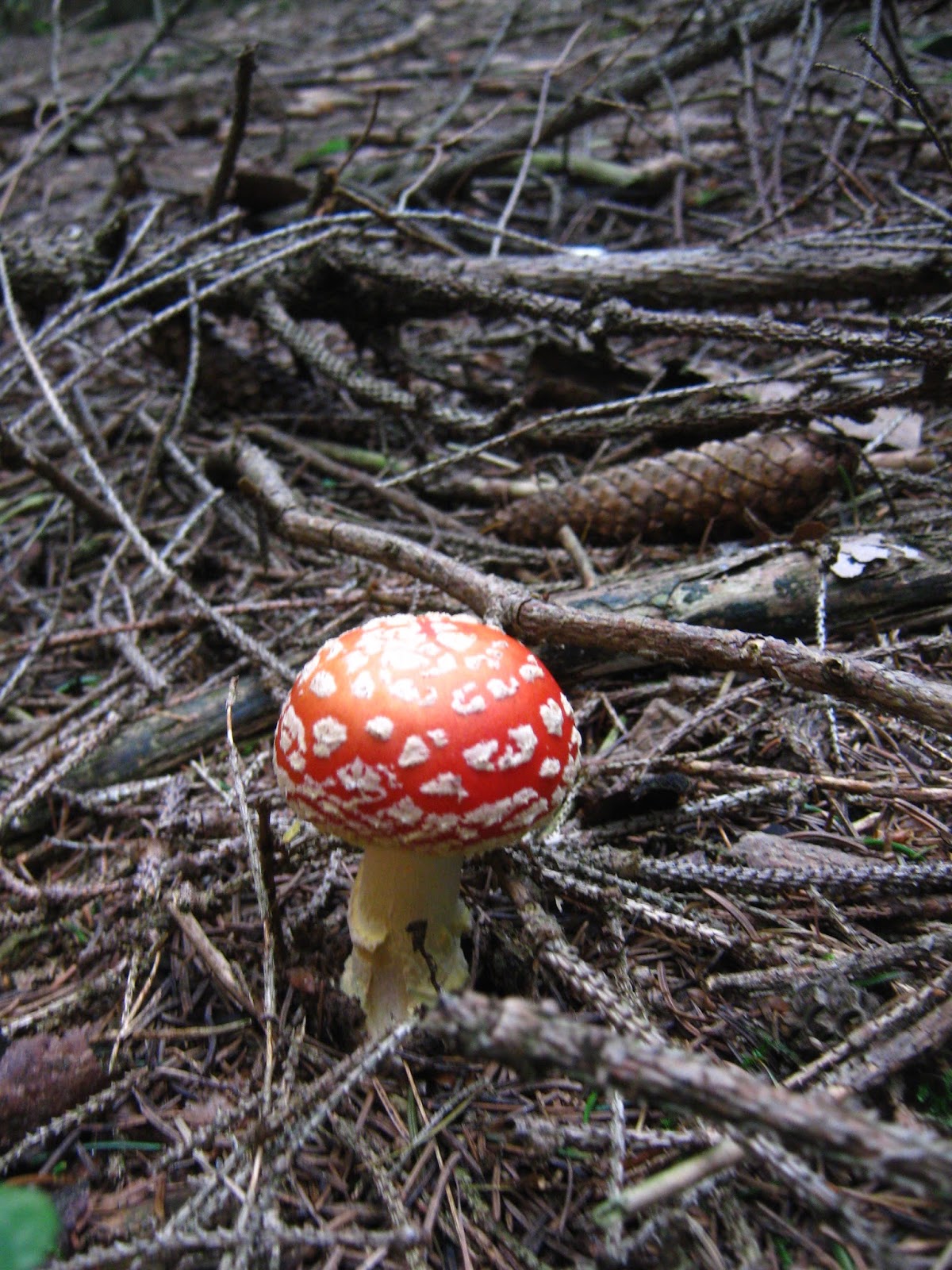
Yesterday, I wrote about some of the birds I saw in Stadtwald Lemgo. There was also some amazing fungi in the wood, particularly in the coniferous parts, and unlike last time I was looking at fungi I had my camera on me, so let’s take a look!


These are all Fly Agaric, the classic ‘toadstool’ fungi, which I’ve seen in the UK before but never so many at once- in some parts of the wood they were very numerous. There were lots of different sizes and levels of spottiness.


This is another one I’ve seen before, the Shaggy Inkcap, in two levels of size and inkiness! These were found outside the wood, on the grassy verge of the road leading to it.


Now this is a new one for me: it’s another agaric, this time Verdigris Agaric. Its striking green colour caught my eye almost as strongly as the bright red Fly Agaric, and like them it has white spots. I think this one looks a little like those colourful macaroons you can get! Only poisonous. ^^


This one also caught my eye because of its unusual colour;
I think it’s Russula fragilis which unfortunately doesn’t seem to have a common name Actually it does! It's Fragile Russula, which I found out from scrolling down on this factsheet about the Charcoal Burner fungus. So its common name is just a translation of the Latin name but that's fine by me! (Though according to the factsheet, both the Charcoal Burner and the Fragile Russula have variable colours so it could be hard to tell the difference by colour, and my photo could be on either. As the Charcoal Burner is also called Parrot Russula so I'll tag this post Russula for now.)


This fantastic thing was the brightest of all! It reminded me of a piece of coral rather than something you’d find in a wood. It’s actually caused a bit of an ID conundrum though, I now think it’s Yellow Stagshorn but initially thought it was Meadow Coral. Meadow Coral can be found in woods, but Yellow Stagshorn attaches itself to conifer roots, and it was found in a conifer forest. Was it attached to a root? I couldn’t say and there’s no way I can go and check now, I wish I’d taken more photos of more of the different specimens of this fungi that were around! I’d never seen anything like it and had the sort of idea that it would be an easy ID, but actually there are many coral-looking fungi, and both the Meadow Coral and the Yellow Stagshorn are common! Must keep an eye out for coral fungi in the UK. Anyway, if you can solve this ID mystery please do drop me a comment and let me know! I would be so grateful! :)

Update (22/11/13): Was doing some research on fungi today and found this photo of the Meadow Coral, which doesn't look anything like my photo, so I think I have Yellow Stagshorn here.


And finally, I almost missed these tiny little things that were next to the path leading out of the wood. I’m pretty sure they are Field Bird’s Nest, which is such a brilliant name- they even look like they have little eggs inside them!

That was all the fungi I photographed, but there was something else just as brightly coloured: take a look at this little guy!


I say little, but as slugs go he’s enormous. And WHAT a colour! I’ve never seen one like this before. I’ve done a little research and I think he might be a Red Slug, though I’m happy to be corrected. I wish I had a book on slug species! I saw one in the UK recently with some gorgeous patterning which I would have loved to identify.

Tomorrow: the birds I saw on the ferry crossing!

Monday, 11 November 2013

German Adventures part 1: What's in a name?


My sister is doing French and German at university and she's currently living in Lemgo, Germany, for her year abroad. Last month my parents and I went out there to visit her. Lemgo is in north-west Germany, and my dad doesn't fly so to get there we took the ferry from Dover to Calais, then drove through Belgium and the Netherlands to get into Germany. Five countries in two days! It was exhausting.

Of course, when my sister was settled in at Lemgo (she lives in a granny flat-type thing under a house), I had one question- 'what's the wildlife like there!' She couldn't tell me much, but from the minute I arrived I had my binoculars out, and practically never put them away. I was determined to find out everything I could about the wildlife of Lemgo, because I don't go to other countries very often and I wanted to make the absolute most of the chance to see wildlife outside the UK. On the day we arrived my sister had some exciting news: she had seen a Red Squirrel from her garden window that morning! On the second day of our stay we all saw one: a dark red, beautiful, tufty creature with a lovely thick tail, perched in the garden apple tree and then running off over the bushes with a piece of apple in its mouth. Germany never allowed Grey Squirrels to become introduced (I hear the closest ones on the Continent are in Italy), and it was wonderful to find out that the Grey Squirrel problem is not all over Europe. For some reason it hadn’t occurred to me that it wouldn’t be. Though Germany does have Racoons- descendants of escaped pets, apparently!

The weather confusingly went from being what my sister called ‘coat and gloves weather’ before we came, to a humid, sweaty mildness, though the leaves were turning autumn shades beautifully all over Lemgo. I couldn’t resist starting a small garden list for the view out of my sister’s window, after 15 minutes of watching produced Blue Tits, Blackbirds eating elder berries, a gorgeous male Bullfinch, a Great Spotted Woodpecker and a House Sparrow in quick succession. (The House Sparrow, a male with only a tiny black bib, appeared to be picking up nesting material- perhaps one of this year’s birds confused by the warm weather?)

The view over Lemgo from the park. Look at those autumn shades!

But things got even better! 5 minutes away from my sister’s place is a large, mixed deciduous and coniferous wood, and with the leaves on the deciduous trees changing bright colours, there couldn’t have been a better time of year to visit. Before we’d even visited the wood I got a taste of the wildlife there. While we were waiting for a bus near my sister’s home, I looked over towards the forest and saw a Buzzard circling over the trees, along with another soaring bird of similar size but which wasn’t holding its wings in the typical Buzzard shallow ‘v’. Looking through my binoculars I saw it was all white underneath, which most Buzzards aren’t, and had a longer tail which it did not spread in flight. It was, in fact, my second Goshawk ever! Unlike in the UK Goshawks are not rare in Germany at all; it has the highest number of breeding pairs in Europe apart from Russia, which is of course a lot bigger. Then later when I got the chance to visit the wood properly I happened to glance upwards, and there gliding above the treetops was another Goshawk, this time being mobbed by another bird, a Sparrowhawk that looked absolutely tiny in comparison. I love seeing mobbing situations that involve birds of prey mobbing other birds of prey, and this also gave me a great chance to see the size difference between Goshawks and Sparrowhawks, two species that are often confused in the UK but that there is no confusing when they are seen together!


I had heard that Goshawks were much commoner in Germany but seeing these two birds without any effort at all took a little getting used to, especially after all the multiple journeys and searching it took to see my first one in the UK. During the visit I was able to meet and chat to a German birdwatcher (my sister’s professor’s wife) who showed me all her bird books and we got talking about our favourite visitors to our gardens. She had seen Hawfinches in her garden! I told her about the Yellowhammers that visited our garden last winter, and the Sparrowhawk that had started to visit regularly (the male involved in last post’s clash of the titans, though he seems to have moved on at the time of writing), which I described as a hawk that is commonly seen in gardens. Using the book I was able to show her which one (the German for Sparrowhawk, awesomely, is Sperber), and she said ‘oh, I thought you meant Habicht’, which is Goshawk. Apparently Goshawks are seen in gardens, in Lemgo anyway! I think Habicht might translate as just ‘hawk’. I love finding out about different country’s names for birds. My favourite example of a different bird name was one of our hostess’s favourite garden visitors, the Wintergoldhänchen or Goldcrest, whose name translates as ‘winter gold chicken’. Firecrest, incidentally, is Sommergoldhänchen (summer gold chicken). The summer and winter parts make sense as in a lot of Germany Firecrests are summer visitors only, and while Goldcrests are found all year round, if it’s anything like Britain they are much more secretive in their breeding season, and a lot more visible in winter when the leaves are off the trees and they tag along with winter tit flocks. The part that really doesn’t make sense to me is the ‘chicken’ part. How can such a teeny bird be compared to a lumping great bird like a chicken? Very strange!


Stadtwald  Lemgo, or Lemgo town forest, with the evening light shining through the trees.

 It’s a good thing my sister isn’t that into wildlife as if she had been she wouldn’t have done any work due to spending too much time in those woods! I could have spent every daylight hour there, seeking out its feathered inhabitants. It was hard to find the birds in the deciduous parts as they were almost silent, but the coniferous parts were filled with little ‘see-see-see’ sounds. Being with family I often wasn’t able to take the time to wait for the birds to show themselves, but at one point I could hear flock calls above me and sat down to wait for a while. After a moment a small bird came into view, and I got an impression of a big, fluffy head, finely barred in white and black, before it disappeared again. I can’t be certain because I didn’t see it very well, but I think it was my first ever Crested Tit! Like the Goshawk, the Crested Tit in Germany has a much wider range than in the UK, where it is restricted to the Caledonian forests in Scotland. Speaking of different ranges, I later saw a Treecreeper...or it could have been a Short-toed Treecreeper, because their ranges overlap over that part of Germany, and they are practically impossible to tell apart by sight in the field. In some parts of Europe you can only find Short-toed’s, so it would be as easy there as it is in Britain, (where you can only find Treecreepers except for very rare vagrant Short-toed’s). So, my notebook just says Treecreeper for now! Maybe one day I will be able to distinguish them by call, if I somehow become well-versed in Continental birdwatching...


Tomorrow: some of the fungi I found in Stadtwald Lemgo!