Every British birdwatcher has a favourite duck. Anyone who has seen Spring/Autumnwatch with Chris Packham and Martin Hughes-Games arguing about whether the drake Pintail or drake Smew is the prettiest and most elegant of all the ducks, and any young birdwatcher who has ever pored over the pages of their new bird book knows it. In Britain they are some of our most colourful species, and a lot of the most colourful species are easy for even a beginner to see. When I was young my favourite was the drake Tufted Duck, with his striking black-and-white plumage, purple-sheened head and adorable tuft on the back of his head. Then for ages I loved the Smew. Now my favourite is another sawbill-the fantastic Red-breasted Merganser. I saw a sizeable flock of them a few weeks ago and felt inspired to write about them! Especially as my camera is broken so I can't photograph fungi any more. :( What terrible timing, right in peak fungi season!
Showing posts with label feeding. Show all posts
Showing posts with label feeding. Show all posts
Tuesday, 2 December 2014

Monday, 7 July 2014
The Black-headed Gull Colony- sketchbook

I wrote last time about the Black Swans and their mating dance at Titchfield Haven nature reserve, which was fascinating but what really draws me there every spring is the amazing colony of Black-headed Gulls that assembles every year on one of the scrapes! This colony is carefully protected with controlled water levels and an electric fence to deter ground predators, and is a relatively recent addition- I've been visiting regularly for about 15 years and I can confirm that it wasn't there during my early visits. It's wonderful that they have been able to create this excellent habitat for the birds to breed. There's a hide overlooking the main scrape, where you can get fantastically close views of the gulls interacting, and honestly it's so fascinating I could watch (and sketch) all day! Black-headed Gulls are so commonly seen scavenging in towns and flying around that it's easy to take them for granted, but breeding season is the most fascinating time to watch any species' behaviour and they are no exception.

1. Courtship (21/3/14)
On this visit I wasn't sure if the colony would be there yet, but it was fully assembled. It's only when I visit this colony that I realise the variety of sounds Black-headed Gulls can make, and most notably, how loud they are capable of being! You can hear them all over the reserve. Most other species that normally live there stay away from the scrape at this time. ^^
The Black-headed gulls were all assembled, but the actual breeding part was only just getting started, and in fact there were a few that didn't quite have their full breeding caps yet (the 'black' cap, actually dark brown, which gives the gull its name). But pairs were definitely forming- everywhere I looked I could see pairs of gulls sitting close together, and one always seemed slightly bigger than the other. When I wrote about the Herring Gulls I mentioned learning that males in that species are bigger than females, and wondered if Black-headed Gulls have this too. It wouldn't normally be possible to tell but having them all sitting in pairs was a useful frame of reference. However the difference may have seemed more pronounced than it really was because the males were showing off so much! They were standing tall, calling all the time with their throats puffed out, and stretching their necks to make the cap look bigger, with the female staying close by their sides.

In one of these pairs, I watched the female start pecking at the male's beak, in exactly the way the Herring Gull chicks from my post above pecked the red spot on their parent's beaks to get them to regurgitate food. Black-headed Gulls don't have pecking spots (their bills are all one colour and dark red), but it seemed to work the same way as the male suddenly regurgitated a couple of lumps of food (even he looked a bit surprised about it! Though that might have been just me XD) for the female to eat. I've seen the female from pairs of birds from other species using similar techniques and it's always fascinated me. Sometimes I think the female is testing the male as a provider by acting like their future chicks will and stimulate his instincts for feeding them, and sometimes I think she is using chick behaviour to get him in the mood for having babies! But most importantly, she needs to be fed to build up her strength for laying the eggs. What was funny with these two was that while the female ate one piece of the food, the male quickly snapped up the other one as if he hadn't meant to give her so much!
 |
| This isn't a sketch of the actual regurgitation! It was too quick a moment for that. Just someone poking at pebbles. |
But that wasn't all the pairs were doing to bond- they were also displaying for each other! I've watched this colony before, but never this early, so I'd never seen them display before. The gulls would make deep 'bows' to each other, dipping the heads low and raising their behind as high as possible, with the tail fully spread, before coming back up and bending their neck as far as possible upwards so it looked bent round almost at a right angle. It was really strange to watch, not least because the male would sometimes be in the middle of a bow before realising another male was getting too close to his mate, and would suddenly burst out towards the invader to scare him away. It kind of ruined the poise of his display, but needs must!
 | |
| My attempt at capturing the 'bow' |
Another notable thing was the way the birds (particularly, I think, the males) were holding their wings when they were with their mates. Normally a standing gull has its wings tucked flat against its body, but these displaying birds held their wings slightly outwards from the body, in a way that reminded me a little of how male Mute Swans raise the secondaries of their wings up over their backs when they are swimming along. In swans it makes their plumage look particularly fine, and it made the gulls' white and delicate grey feathers look especially smooth and pristine too, but I suspect the actual purpose of this was the same as the swans'- to look bigger and stronger, and threatening to rivals!

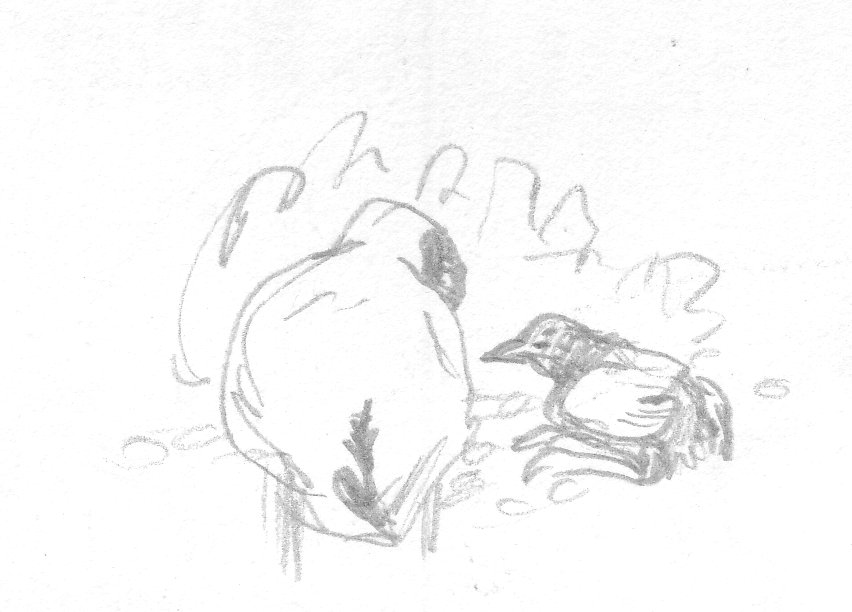
Some of the pairs were starting to build nests, but this didn't mean much more than them starting to pick up sticks and bring them to one spot, where one gull (the female?) would be sitting tight as if to 'reserve' it for their use. Gulls aren't great nest builders but I suspect it was still a bit early to see any proper nests. The one in my sketch below kept picking at a plant in front of her that was much too big; there was no way she was pulling it up to get it into the nest but she didn't seem that worried.
 |
| Nest building, or just picking at it? |
Not all the other birds were elsewhere- there were notable numbers of Oystercatchers on the gull islands too (whether nesting or just hanging around I don't know), and a few ducks, and a nest building Moorhen pair! Their nest was much further along than the gulls', and was nestled in a patch of reeds just above the water level. They were nice and close to the hide so I got a sketch.
 |
2. Nest Building and Incubation (2/5/14)
Flash forward to about a month later, and I visited the colony again to see how their breeding season was going.
It had come a long way! There were nests everywhere, with sitting gulls covering most of the islands on the scrape. Some of the nests near to the hide were even pretty impressive, with large piles of sticks on top of clumps of reed, and incubating birds on each one. None of the near nests had any chicks yet that I could see, though it's possible that some of the nests further away had some.
Sadly the Moorhen's nest was no longer there, and the clump of reeds the pair had been using was now occupied by a gull's nest. Presumably the gulls had muscled the Moorhens away from the spot, and possibly even used the Moorhen's nest as a base for their own nest! I did spot some Moorhens swimming along the side of the scrape though.
 |
| I think the nest on the left is the ex-Moorhen nest, now firmly occupied by an incubating gull |

I watched a different pair mating, but they seemed to be having a little difficulty! When birds mate (most species, anyway) both of them have to twist their tails around enough for their sexual organs, the cloaca, to touch together. However the male was having so much trouble balancing on her back, flapping his wings around, and waving his tail widely, it didn't seem like they were being very successful!

All the nest on the scrapes and in the reeds were being fiercely defended, with intruders being chased away with a threatening stance and a fast swim in their direction! Here's my attempt at capturing it:

3. Chicks! (28-05-13)

Some of the nests were still at the stage I left them that at last time (or...next year...sorry this post has such a weird timeline!), with birds sitting firmly on eggs and bringing nesting material. I also saw one pair switch which bird was incubating, which was interesting to see. From this I found out that Black-headed Gulls both incubate, which means I was often just guessing about which bird was on the eggs when I talked about them earlier, and noticing roles as clues (like bringing nesting material- is this a way for the male to impress the female?).


 |
| It's easy to get behind on your feather care in the hecticness of the breeding season! |

 |
| This was one member of the pair who switched incubating roles. It had a distinctive brown smudge on the back of its neck below its cap. |
 |
| The other (assumed male by me at the time) returned at feeding time! |
At this stage a few birds, like the one above, were still sitting on eggs, but there were chicks absolutely everywhere! They were speckley brown and fluffy, with legs that seemed too big for their bodies.


It was raining throughout the visit, but that was ok. When you're in a hide and you're watching nothing but water birds, rain really doesn't effect your birdwatching!
 |
| Getting wet = not a problem! |
But while the adult birds' feathers were keeping them relatively waterproof, the chicks were all still downy and not waterproof at all, leaving their parents with the job of acting as umbrellas for them. This was done by the parent birds holding their wings out from their bodies as far as they could, and the chicks crowding in as closely as possible. It looked like a tight squeeze! It also looked pretty uncomfortable to have wriggly, pointy-beaked chicks stuffed up under your wings.


Two seemed to be the average number of chicks in each family, or sometimes three, but one family that I made particular notes on stood out.

There were a few older chicks that were bigger, had a few body feathers and were roaming further afield, but they were easily intimidated by the noise and fights constantly going on among the adult gulls. I watched as a couple of these 'teenage' chicks accidentally got in the way of a fight among adults, and to get away from it they left the island they were on and hurried out into the lagoon where it was so deep they seemed to be almost swimming! Perhaps they were swimming- adult gulls swim after all.
As time goes by in this colony, I've noticed that more and more Common Terns arrive. They don't nest anywhere on the main lagoon, but a few pairs nest in lagoon behind it that seems less popular with the gull colony, and some more are on special tern nesting islands in the lake next to the lagoons (though Oystercatchers and the odd pair of gulls take up a few of the platforms too). Seeing the terns contrasted with the Black-headed Gulls is always fascinating because it makes the terns look tiny. I think of the Black-headed Gull as small because next to Herring and Lesser Black-backed gulls, it really is. But the Common Tern is much smaller again. In fact all the sea terns, even the bigger Sandwich Terns, are smaller than the Black-headed Gull. Then again, I think I checked it out and found that the smallest sea tern we get in Britain (the tiny Little Tern) is bigger than our most numerous marsh tern! (the Black Tern- I did see some once in constrast to Common Terns and they certainly were weeny.)

4. All grown up (15/6/14) (no sketches this visit)
Now in 2014 again, my latest visit to the colony was in mid-June where I was hoping to see more small chicks. There were still some that were downy, but on the closest islands the babies were larger and almost fully covered with feathers, though they didn't yet have the streamlined shape of the adult birds. A Black-headed Gull's first plumage is a mixture of brown and white, mostly brown but with patches of white that make them look very confusing, at just a glance you're not sure what species you're looking at! If they survive until winter, the chicks will moult into a plumage with much more white, with brown fringing across the wings and a dark band at the end of the tail, like the bird in the photo below.
 |
| This wasn't taken at Titchfield Haven but was actually from winter 2010, in a park in Paris! I know it's random but it makes good reference for this post. I didn't see much wildlife in Paris so probably there won't be a full post about that. ^^ |
Black-headed Gulls won't breed their first summer, and gulls you see in spring and summer that look almost like adults, but with some brown fringing and remnants of the black tail band, are probably always one year old. There were a few of these hanging around in the colony this year, and I found myself wondering if any of them were chicks that I sketched back in 2013! Even if not those specific ones, it seemed likely that they were born at Titchfield Haven, and whatever their reason for hanging around there I expect it will help them when they breed to have been around nesting adults when they were younger!
Sadly on this visit I couldn't check on the status of the reed nesting birds (whether the pair had succeeded in making their 'in-between' nest, etc) because the vegetation in front of the hide had grown so high that I couldn't see low down enough. But I did see something rather gratifying: two families of Moorhens! I didn't see either of their nests but one had some medium sized but still downy babies, and the other had three absolutely tiny babies! The tiny chicks were roaming quite far afield but the adults had a close eye on them, and they stuck to the side of the scrape and well away from any of the islands.
Speaking of meals, I was viewing from another hide (overlooking the neighboring scrape but you can still see what's going on on the large scrape from a distance), when there was a scuffle on the main scrape- a Lesser Black-backed Gull swooped down and targeted a family of Avocets. (there's a few pairs that breed at Titchfield Haven! It's really cool. They tend to breed further from the hides though so it's harder to observe them.) The parent had at least two large chicks, almost as big as her and mostly black and white but still with grey baby feathers on their backs. She was not happy with the gull's proximity to her babies and shooed it off angrily, with a strangely musical alarm call. I couldn't help thinking that her chicks were probably too full grown to be caught by the Lesser but it was impressive to watch! The Lesser didn't give up however, and swooped over to the gull nests, where despite being hounded by the adult Black-headeds, it managed to catch one of the downy chicks. It quickly bore the chick away to the scrape in front of my hide where there were fewer Black-headeds about, and began pecking at the chick and holding it underwater to kill it. A man in the hide who was a regular there told me it had taken 'dozens' of the chicks. But even if it had, and even if it was quite sad to watch, the Lesser Black-backed Gull had a good reason- living, just like any other bird. Any bird species only has to raise enough chicks every year to replace older birds who have died to keep the population stable, and the colony certainly didn't have as many chicks as it did on my visit in 2013 at this later stage, but it's not like there were incredibly few either! And soon the ones that are still downy will be feathered, and too big for the gull to carry off, and it will have to find a new source of food. The mortality rate of course includes first winter deaths, and then more in first summer and second winter, but the ones who survive into their second summer when they are old enough to breed will have already survived a lot, and they will hopefully be equipped to survive a lot more. The oldest recorded Black-headed Gulls have been in their twenties.

Thanks for sticking with me in this odd travel in time, I hope it made sense! I know I will be watching this colony (and sketching it!) for many years to come. It's not only fascinating, but funny! And now whenever I see those common, town dwelling gulls that are Black-headeds, I think about how much they had to go through to get up, because I've seen it happen. Watching common birds on their breeding sites will ensure you never take them for granted again!
Thursday, 23 January 2014
Amorous Activities in the Pigeon Family
This is sort of a continuation to my last post about early signs of Spring caused by the mild winter, but only sort of, as hopefully I will show! On a walk about a week ago, I found this:

This is a Woodpigeon's egg, which has been predated. If it had hatched naturally it would have broken into two halves due to the way a baby bird pecks around an egg to escape it using its egg-tooth. And according to my trusty Helm Identification Guide 'Tracks & Signs of the Birds of Britain and Europe', a predator such as a weasel would smash the whole egg up when it ate it. The hole in this otherwise intact eggshell shows that it was predated by a bird, such as a corvid.
The reason I said that this is only sort of a sign of early Spring is that Woodpigeons (and other pigeon species such as Collared Dove) are known to breed at all times of year. They can do this because, unlike most passerines, they can regurgitate food to feed to their babies in a substance known as pigeon milk, meaning as long as there's food for the adults there's food for the babies. Other species of birds, such as Blue Tits, need soft food such as caterpillars and insects for their babies, so they have to breed at the right time of year for that food.
However, weather still matters and I doubt Woodpigeons would have been breeding last January. It was just too cold. And even with this year's mild winter, if this egg hadn't been predated I wouldn't have expected it to survive. Woodpigeons build very basic nests of just a few twigs in a tree, and it's been SO windy and rainy this winter that the nest would have probably blown down.
Speaking of breeding behaviour in the pigeon family, today I was looking out into my garden and saw a pair of Collared Doves start mating! Then, as if that wasn't enough, only a few minutes later there was a pair of Woodpigeons who also began to mate, but this time I got the chance to see a little bit of their courtship too. What first drew my attention was one pigeon began pecking at the beak of the other, and then stuck its beak right inside the other's; it was being fed on pigeon milk! I'd never seen anything like it before. I guessed the one doing the feeding must have been the male, and sure enough when they began to mate it was this bird that jumped on top. Before mating they sort of snuggled up together, with the male puffing up his breast feathers to look bigger.
I've talked about courtship feeding before, and how I've seen females in both Blue Tits and Carrion Crows use a wing-fluttering display to show they want to be fed by the male. The female pecking the male's beak was different though, and reminded me more of the Herring Gull chicks when they pecked their parent's beak on the red pecking spot to get them to regurgitate. Only in the case of the adult Herring Gulls, they were regurgitating a large lump of food onto the ground for the chicks, while the Woodpigeon behaviour I saw suggests that their young take food straight from the parents' beaks. Well, the name 'pigeon milk' does suggest liquid! The male Woodpigeon was showing the female how well he'd be able to feed babies when it came to the time, as well as how well he would feed the female while she was laying and incubating. It looks like more eggs are coming in the future, so let's hope we don't get any more storms!
Woodpigeons are such fascinating birds to watch, especially as you can often observe their behaviour very closely when they are in gardens and parks. We have a ground feeder in our garden and I've noticed how dominant Woodpigeons have a sort of 'lurch forward and wing-flap' gesture that they do to scare off other birds feeding on it. Or at least, it's supposed to! It works on other Woodpigeons and on Collared Doves; they all back off. But Starlings tend to ignore the gesture completely! Starlings may be a good bit smaller than pigeons but they aren't easily intimidated. And perhaps pigeon body language doesn't translate well outside the family?
I hope I'll have the chance to write more about Woodpigeons in the future, because I've seen all kinds of interesting interactions among them. I've seen them squaring up, bowing to each other, standing up as tall as possible, mimicking each other's behaviour...what do these behaviours mean? To guess at that I'd need to watch them more closely, which I plan to do in the future. Since writing this blog I've started watching bird behaviour more closely than ever before, and I feel like I'm finding out new things all the time! As always, please do submit stories of your own about bird behaviour- have you seen any pigeon courtship this winter? If so, leave me comment and tell me all about it! :)
**************************
This is unrelated to pigeons, but on the same walk that I found that eggshell, I saw this:

On the left is a small animal hole (I'd say the photo is about actual size), and in the middle and bottom you can see the shells of seeds. I don't know what species lives here but I'm sure its either a mouse or a vole, as they both eat seeds. Leaving all the seed shells outside reminds me a bit of our hamster, who tends to spit his empty shells outside of his bed! Of course a small animal that lives in a hole doesn't really need to hide its seed shells, as it is safe inside and the hole is so obvious anyway.
**************************
And finally, and back on the pigeons, here's a slightly disturbing pop cultural reference to pigeon milk! I'm a big fan of the game series Animal Crossing, in which there's a pigeon character named the Brewster who owns a coffee shop. After you get to know him a bit, he offers you some pigeon milk to put in your coffee. Um........:O
Someone in this game's development had a sense of humour alright!
...But as you can see from the picture, in the game your character seems to really enjoy the pigeon milk-infused coffee. So I guess it's not so bad!
This is a Woodpigeon's egg, which has been predated. If it had hatched naturally it would have broken into two halves due to the way a baby bird pecks around an egg to escape it using its egg-tooth. And according to my trusty Helm Identification Guide 'Tracks & Signs of the Birds of Britain and Europe', a predator such as a weasel would smash the whole egg up when it ate it. The hole in this otherwise intact eggshell shows that it was predated by a bird, such as a corvid.
The reason I said that this is only sort of a sign of early Spring is that Woodpigeons (and other pigeon species such as Collared Dove) are known to breed at all times of year. They can do this because, unlike most passerines, they can regurgitate food to feed to their babies in a substance known as pigeon milk, meaning as long as there's food for the adults there's food for the babies. Other species of birds, such as Blue Tits, need soft food such as caterpillars and insects for their babies, so they have to breed at the right time of year for that food.
However, weather still matters and I doubt Woodpigeons would have been breeding last January. It was just too cold. And even with this year's mild winter, if this egg hadn't been predated I wouldn't have expected it to survive. Woodpigeons build very basic nests of just a few twigs in a tree, and it's been SO windy and rainy this winter that the nest would have probably blown down.
Speaking of breeding behaviour in the pigeon family, today I was looking out into my garden and saw a pair of Collared Doves start mating! Then, as if that wasn't enough, only a few minutes later there was a pair of Woodpigeons who also began to mate, but this time I got the chance to see a little bit of their courtship too. What first drew my attention was one pigeon began pecking at the beak of the other, and then stuck its beak right inside the other's; it was being fed on pigeon milk! I'd never seen anything like it before. I guessed the one doing the feeding must have been the male, and sure enough when they began to mate it was this bird that jumped on top. Before mating they sort of snuggled up together, with the male puffing up his breast feathers to look bigger.
I've talked about courtship feeding before, and how I've seen females in both Blue Tits and Carrion Crows use a wing-fluttering display to show they want to be fed by the male. The female pecking the male's beak was different though, and reminded me more of the Herring Gull chicks when they pecked their parent's beak on the red pecking spot to get them to regurgitate. Only in the case of the adult Herring Gulls, they were regurgitating a large lump of food onto the ground for the chicks, while the Woodpigeon behaviour I saw suggests that their young take food straight from the parents' beaks. Well, the name 'pigeon milk' does suggest liquid! The male Woodpigeon was showing the female how well he'd be able to feed babies when it came to the time, as well as how well he would feed the female while she was laying and incubating. It looks like more eggs are coming in the future, so let's hope we don't get any more storms!
Woodpigeons are such fascinating birds to watch, especially as you can often observe their behaviour very closely when they are in gardens and parks. We have a ground feeder in our garden and I've noticed how dominant Woodpigeons have a sort of 'lurch forward and wing-flap' gesture that they do to scare off other birds feeding on it. Or at least, it's supposed to! It works on other Woodpigeons and on Collared Doves; they all back off. But Starlings tend to ignore the gesture completely! Starlings may be a good bit smaller than pigeons but they aren't easily intimidated. And perhaps pigeon body language doesn't translate well outside the family?
I hope I'll have the chance to write more about Woodpigeons in the future, because I've seen all kinds of interesting interactions among them. I've seen them squaring up, bowing to each other, standing up as tall as possible, mimicking each other's behaviour...what do these behaviours mean? To guess at that I'd need to watch them more closely, which I plan to do in the future. Since writing this blog I've started watching bird behaviour more closely than ever before, and I feel like I'm finding out new things all the time! As always, please do submit stories of your own about bird behaviour- have you seen any pigeon courtship this winter? If so, leave me comment and tell me all about it! :)
**************************
This is unrelated to pigeons, but on the same walk that I found that eggshell, I saw this:
On the left is a small animal hole (I'd say the photo is about actual size), and in the middle and bottom you can see the shells of seeds. I don't know what species lives here but I'm sure its either a mouse or a vole, as they both eat seeds. Leaving all the seed shells outside reminds me a bit of our hamster, who tends to spit his empty shells outside of his bed! Of course a small animal that lives in a hole doesn't really need to hide its seed shells, as it is safe inside and the hole is so obvious anyway.
**************************
And finally, and back on the pigeons, here's a slightly disturbing pop cultural reference to pigeon milk! I'm a big fan of the game series Animal Crossing, in which there's a pigeon character named the Brewster who owns a coffee shop. After you get to know him a bit, he offers you some pigeon milk to put in your coffee. Um........:O
Someone in this game's development had a sense of humour alright!
 |
| Source: http://soapboxview.blogspot.co.uk/2013/08/the-animal-crossing-new-leaf-photo-post.html |
...But as you can see from the picture, in the game your character seems to really enjoy the pigeon milk-infused coffee. So I guess it's not so bad!
Tuesday, 29 October 2013
Sparrowhawk Sketches
Yesterday I looked out into the garden and saw a female Sparrowhawk plucking a large kill on the patio, less than 5 metres away! At first I thought the kill was a Collared Dove but then identified it as a Woodpigeon. All the drama and movement of the kill had happened completely without me noticing. Worried about putting her off her kill, I very quietly crept away and went upstairs to my room, from where I could watch her, and sketch. All my sketches are from a slightly above angle because of being upstairs.

I wanted to
look in detail at the Sparrowhawk's feathers. In this
sketch you can see that the tail has a thick band of darker grey at the end (with
a very thin stripe of white right at the end, but my sketch isn’t that
detailed!) and 3 bars across the middle of the tail. The white ‘eyebrows’ over her big yellow eyes
curve round to meet at the back.
The female
plucked her kill busily for a while, though she never stopped flicking her head
this way and that to check for danger in between beakfuls of feathers. Then suddenly a male Sparrowhawk seemed to
appear out of nowhere, about a metre and a half away from me on the roof of our
garage. This bird has been a regular visitor
to our garden for the past week (the female was a newcomer), and he’s a
particularly colourful bird with deep orange eyes, red cheeks and red barring on
his breast, and even his tail feathers seemed to have an orange glow in the sun. As soon as the female saw him, she opened her
wings and spread her tail to mantle her kill so as to hide it from him, and glared at him with a terrible, yellow
stare.

While
fixing him with her gaze she was very still so I was able to get a sketch,
which you can see in the top left of this page. It
was quite something to see. The male was
absolutely not going to get any closer.
A little male hawk about the size of a Collared Dove was not going to
approach the big broad female, bigger than the Woodpigeon she was eating. He didn’t stay long, flying away in the direction
he came, and she kept mantling for a little while before digging her talons
into the kill and flutter-jumping onto the lawn, moving the kill a few metres
away from where she plucked it. Perhaps
she worried the male would come back and attempt to steal some of the kill.

On the left
you can see her mantling using her spread tail.
Then after moving the kill she sat for a while on it before starting to
eat it. She appeared to be bracing her
tail on the ground while standing on the kill, which was interesting to see,
not sure why but maybe it helps her keep her balance while she eats?
On the right
of this page I was trying to get the beak right. The head of the bird is flat and there’s a
tiny ‘forehead’ before it dips down to the beak. There’s a yellow patch of skin around the
beak which extends up the forehead in a thin line, and the main body of the
beak is grey with the nostrils at the base.
The beak was easily the hardest thing to get right on these sketches, it’s
so small and the shape was hard to see without my binoculars which meant every
time I drew it I had to do it one handed.
Consequently I missed it out of a few sketches!
|
|

She stayed
still for so long that I was able to draw the formation of feathers on her
wings. Natural History illustrators who
draw and paint birds show every feather on the plumage, and I want to be able
to do that too, so I resolved to look more carefully at birds whenever I
have the chance to draw one that’s so close, particularly a larger bird where
it’s easier to see the feathers.

As she began
to eat the pigeon, shifting her talons around to get a better grip, I was able
to draw them. Compared to the size of
the bird, the yellow talons are quite slim, but you can see the strength in
them when the hawk has a grip on something, and the black claws are long compared
with the length of the toes. One of my
favourite things about Sparrowhawks are their extremely fluffy, barred ‘trousers’
that extend halfway down the legs, so I’ve paid particularly attention to them
on the right of the above page.
After eating
a bit of the kill, the hawk showed signs of wanting to move it again, but this
time to take off with it properly. I’ve
seen Sparrowhawks eating their kill in trees before, so maybe that was what she
wanted to do. When she was plucking and
eating she never stopped warily looking out for danger, and it goes to show
that just because an animal is a predator that doesn’t mean it has nothing to
worry about. A ground predator like a
cat or fox could attack her while she was on the ground for so long, or steal
her kill, and even if the male Sparrowhawk was too small to try this, a bigger
bird of prey might have been the next to try for all she knew! In the wild, no animal is ever completely safe
from attack.
She hooked
her talons securely into it and tried to take off but it didn’t work, instead
she fell over, wings and tail flailing everywhere. It was clear the kill was still too heavy for
her to carry, so she gave up and kept eating on the lawn.

On the left
is a sketch of her pulling the meat off the carcass in long strips. On the right you can see how wide apart her legs
had to be to let her head bend low enough to tear the carcass, and though I
didn’t capture it well in the sketch, she was bending her head at what looked
like awkward angles to get the meat. I
tried to show the head markings in the sketch in the bottom right, there's a grey
patch of feathers behind the eye of a female Sparrowhawk, and the thin yellow plate above the
beak going up the forehead and bordered by grey feathers on each side. The white eyebrow is quite visible but it’s not clearly defined at the edges, with grey streaking going
into it.

After eating
for a while she tried to move the kill again, but despite having eaten some more
of it she could still only flail about, so she gave up and after a couple of
seconds flew away without it. I went out and had a look, there wasn't all that much left and the head of the kill was completely gone. I watched
her for about 45 minutes overall. It was
fascinating, and the best view of a Sparrowhawk I’ve ever had.
|
Subscribe to:
Posts (Atom)