Happy New Year! Normally it would be time for my new year's roundup but I admit I'm a bit behind on everything. It was a hectic last part of the year with nothing but job drama, then my housemate took the internet a while ago and I won't have it back till Tuesday. I'd like to say that was why I haven't written for a while but actually it's because I've been overwhelmed by everything I've seen and didn't know where to start. That combined with the job drama meant I didn't write. Now that I'm borrowing some wifi I'm going to put a hold on the new year's post until I'm reconnected and for now concentrate on my visit to Titchfield Haven yesterday!
I've been out of touch with bird news without internet but my mum happened to check Titchfield Haven's twitter feed and found out about the Penduline Tits. Three have been reported since mid-December, starting out at Titchfield Haven, moving to the IBM lake in Cosham, and have now returned to the Haven. Despite the blowy, rainy weather we made our way down there yesterday to find that they were currently at the Meadow Hide.
The hide was much more action-packed than usual, both with people (as we were expecting) and with birds. Later after visiting the Meon Shore Hide, which usually boasts the highest numbers of birds, we found that practically all the islands were underwater, possibly explaining why most of the birds were at the Meadow Hide. There were ducks, Canada Geese and Curlews feeding on the field, and a suspicious amount of fluff floating around a patch of bullrushes just in front of the window, even though it wasn't that windy at that point. The bullrush heads were mostly bare but there were a few that still had a good amount of their fluffy seeds on them, and some birdwatchers directed us to the source of the flying seed, the small bandit masked beauty that was the Penduline Tit!
I would judge it to be about the size of a Great Tit, with colouring that reminded me of a Red-Backed Shrike very much- the brown back, grey head and black mask are very similar and I think the Collins Bird Guide mentions this too. Looking at the picture in that book I think this was a female because it had a small mask, whereas the male has a larger one (which would probably make it less reminiscent of a shrike), and our bird seemed pale while the males are apparently brighter. I believe there are two females and a male about but the other two never showed. Not that anyone in the hide minded because this bird was showing fantastically well, it was no more than 10 metres away and was feeding right on top of the reed where everyone could see, pulling out clumps of the fluff to get at the seed. Cameras were clicking and I have no doubt they got some fantastic photos!
Meanwhile, the rest of the birds were putting on a show too. All the ducks were fully post-eclipse and the drakes were strikingly bright (I don't think I've visited wetland since the tail end of eclipse season where everyone's still looking a bit dingy). Not to mention the mild weather was definetly effecting them and courtship behaviour was breaking out everywhere. We spotted a pair of Gadwalls bobbing their heads up and down, mimicing each other. Clearly their courtship was at an advance stage already because they started to mate on the water, the male grasping the female on the back of the neck with his bill and pushing her under. He mated with her several times, allowing her head to come up to breath in between. Duck mating does tend to look brutal but this didn't seem as bad as what I've heard about Mallard mating (I've never seen it but birds have been seen to die during this spectacle). It was more like the Black Swans I saw at the Haven, written about here. Only no swan is going to have a problem with its head going under, and the courtship seemed much simpler with the Gadwalls.
I haven't extensively observed wildfowl courtship but it does seem like mimicry is common. I saw several pairs of Canada Geese doing this too, and noticed that there is quite a sexual size difference when you see two that are clearly male and female together, the male is definetly a size bigger. One pair had a very flirty male who in between mimicing would hopefully peck at the back of her neck, and I'm sure I know what that meant, but she didn't seem ready yet. Interestingly as well as mimicing each others movements, they would also take turns pecking at the other's feathers. Do geese ever preen each other for courtship, I wonder?
This was all very interesting but an even more interesting thing was about to happen. Suddenly the cry 'Marsh Harrier!' went up in the hide, and a large, familiar sillhouette started to glide over the reeds, followed by another and still another. I saw familiar not because Marsh Harriers are common at the Haven (far from it, I've only seen them there once before) but because I've watched them extensively when I lived in Kent, at reserves like Dungeness and Elmley Marshes, and their shape and flight style is very distinctive. They fly low over the marshes, wings in a shallow V, and you can see their head looking down below the level of their wings, looking for prey. On Kentish marshes a harrier's appearance will cause every bird to go up- wildfowl, waders and gulls- and some to mob the bird and try to drive it away. I've seen this many times, but I've never seen a Marsh Harrier actually make a kill. While they probably do sometimes kill small ducks and waders, usually you see them dropping into the reeds and not come back up, and it can be assumed that they caught a small mammal of some sort, or maybe a frog in the summer.
I say this to try and explain a weird thing that happened when the harriers came: despite there being three of them at once (actually four because an adult male appeared a little later on- we decided it was probably an adult male, an adult female, and their two youngsters), none of the wildfowl and waders on the water or the meadows flew up. It was really odd, as normally a bird of prey sillhouette unsettles smaller species whether or not they are actually likely to be caught by it. The four harriers spent a lot of time circling around and gliding slowly over the reeds (they seem to let the wind take them along before turning around and flying into the wind back over the area to carefully comb it for prey) and it caused practically no disruption, and also none of them were mobbed. Are these birds just not used to harriers, unlike the Kentish birds? The harriers certainly didn't breed in the area and probably didn't arrive that long ago so that was all I could think of to explain it.
The two young birds looked very similar to the adult female in plumage, but you could tell which was which by their behaviour. The adult female kept being harrassed by one of the youngsters while she quartered the marshes. Birds of prey seem to keep bothering their parents for food for a long time, which makes sense as hunting is so difficult and they have so much to learn, and I've seen other species do this with calls. For example a young Peregrine trying to get food from an adult is a sound impossible to miss, it's a continual shrieking that immediately alerts you to the presence of a put-upon adult bird being chased around the sky by an insistant and very noisy youngster! And I've seen a Kestrel being bothered by its youngster, which was the only time I've ever heard a Kestrel make a sound, it was a 'ke-ke-ke' kind of noise (possibly where the name Kestrel came from?) and it was also somehow doing the little begging wing-flutter young birds do while in a glide. (It didn't get any food and was in fact probably hindering the adult's hunting efforts!) The Marsh Harrier youngsters didn't seem to be making any noise, unless it was very quiet, but the one that was bothering the female kept flying just under her and swinging its talons upwards to almost connect with hers. I know that Marsh Harriers sometimes pass food to each other in this way during courtship (never seen it but I'd love to!) where its part courtship feeding and part showing off their flying skills and therefore strength, but it seems illogical that they'd waste energy feeding babies this way. However maybe the mimicing of food pass behaviour was supposed to be a way of showing the youngster wanted to be fed? Presumably it could see the female didn't actually have food in her talons right then, but this was a way of saying 'hey, hunt me something!'
I wondered if there was a bit of hunting teaching going on as well. At one point the female and one of the juveniles were on each side of a small flock of Mallards, floating just above them. The ducks seemed completely unbothered until the youngster made a small lunge towards them and they decided to swim away from the area quickly. There didn't seem to be much intent towards the lunge a far as I could tell, but who knows? I don't know how long Marsh Harriers stay with their parents, I'd love to find out more. They are lovely birds, some of my absolute favourites ever, great to watch and known to fly in almost all weathers. I hope they stick around Hampshire for a long, long time.
How was your 2015 everybody? Stay tuned for my look at my 2015!
Showing posts with label courtship. Show all posts
Showing posts with label courtship. Show all posts
Sunday, 10 January 2016

Tuesday, 9 June 2015
Watching Little Grebes Build a Nest
If you're reading that title and thinking 'aren't we a bit past nest building season at this point?' you'd be right! The nest building happened in early May. But it was so amazing that even though it was over a month ago I couldn't not write about it. I have posts cooking up in my brain about wildlife things that happened years ago. Who knows when they'll get written?
Wednesday, 20 May 2015
Auks and Jellyfish at Portland Bill!
This is actually a post I meant to write in April but I've got really behind on my posts recently. In late April I took a drive down to Portland Bill, in the hope of finding migrants and seeing some lovely seabirds.
Saturday, 11 April 2015
A Very Gothic Experience (not really) and more courtship displays
Yesterday I was in a cemetery next to an old church, walking among the graves, when I heard the distant croaking call of a Raven. Looking up I saw the huge, flying cross silhouette of this great and most gothic of corvids, soaring majestically over.
...Well, that would leave out the fact that it was a glorious sunny day, the graves were covered in beautiful floral displays, and a Raven's croak never sounded particularly gothic in my opinion! I've always been struck by how oddly polite their call is, and while it can be heard from a great distance there's nothing loud or fussy about it. Compared with the screeching of Rooks or the harsh 'chak!' of Jackdaws it's really not sinister at all. But it is great for finding them, as the call is unmistakable, and as soon as you hear it just look up and you'll no doubt see a big black bird flying over.
This particular church was at Minstead in the New Forest, whose graveyard is notable for having Sir Arthur Conan Doyle buried there (among the new graves because he was buried far from the church due to his spiritualist beliefs being a bit suspicious to the clergy at the time). There's also a grave which originally had the words 'faithful husband' but after finding out some things to the contrary after his death his widow cut carefully around the word 'faithful' and removed it, so now it just reads something like 'he was a husband'. I guess sometimes that's all you can say. ^^
After visiting the church I went for a walk around the area, and on a field I saw the black and white blur of two Pied Wagtails fighting. It seemed very violent as one kept pinning the other onto the ground, but then as they stayed still for a moment I got a good look at their plumage and realised they were a male and a female. They female crouched down and presented her tail to the male, and began to flutter her wings, and he jumped onto her back and quickly mated with her. In fact it was so quick that I wondered if it had actually succeeded at all. As I wrote about in my Black-headed Gull post, birds mate by touching their sexual organs together, which are similar in males and females and are called the cloaca. (There are a few exceptions to this as in some species of birds the males have penises, I think Ostriches and ducks, but not may others.) With these Pied Wagtails their tails were so long that it looked like a struggle to get them out of the way for long enough to expose the cloaca to each other. It's possible they had the same thought I had as I saw them mate twice more afterwards. The female can only produce one egg a day, and the pair must mate successfully beforehand each time.
Most people know about well-known courtship displays like the mating dance of the Great-crested Grebe, but I'm starting to realise that other species all have their own courtship rituals too, and if you watch them carefully enough at this time of year you might see them for yourself. I never would have guessed that a Pied Wagtail gets in the mood for mating with a vicious fight! To see it for yourself keep an eye on pairs of common birds that you see at this time of year, especially of species that you never normally see together, like Robins. You might see the female being fed, displays of behavioral mimicry, mutual preening (like the famous 'billing and cooing' of pigeons) showing off by the male, and after mating some birds have rituals then too such as calling or spending time close together afterwards. It's tempting to anthropomorphize these birds, and I think we all do to some extent, but all these behaviours have reasons behind them and it's interesting to make a guess at what they are. Feral birds like ducks and pigeons, and even escaped birds if they are living in a natural enough environment, can be great to watch as it's easy to get close to them. I wrote about seeing the Black Swan's mating dance here, and about watching a Woodpigeon feed his mate 'pigeon milk' here.
As I walked through an area of heathland surrounded by conifers I was lucky enough to hear the song of a Firecrest, and get a good view of this wonderfully colourful bird. Firecrests are a hundred times more striking in real life than in pictures, and the yellow-ochre splash of colour on their shoulder is particularly dazzling, especially in contrast to their olive backs and black and white striped heads. Their song is a series of speeding up notes, a little like the Goldcrest's song but all on one note. I've always found Spring Firecrests to be very confident birds, easy to see at close range once you hear them. And they always seem bigger than Goldcrests, though whether they actually are noticeably bigger is perhaps not true. It's the colouring that makes them seem so, and perhaps the confidence soon. Firecrests are one bird I'm proud to say I'm 'getting better at'- I saw my first one with help in 2010 and since then I've been finding my own locally, and can recognise their song.
It's still early April and it's weird to think that while some birds, like the Pied Wagtails, are well on their way to breeding, some of our breeding species are not even here yet! Later on in the Spring if I travel to their New Forest again I'll be able to hear Cuckoos, Redstarts, Wood Warblers, Woodlarks and Tree Pipits, but heard not a peep of any of these species just yet. Meanwhile, the Raven I saw earlier is one of our earliest breeding birds, and could have already fledged his young for the year. It's amazing to think about. One migrant I did see yesterday was the first Swallows of the year, for me at least! It's always lovely to see them come back.
Finally, as I walked through the wooded New Forest enclosures I was impressed to see a species I don't remember when I last saw- I kept passing mounds of earth covered in great swarming masses of Wood Ants! These beasties are about 3 times the size of a black ant, and are more fussy about their habitat. I'm not sure if they actually eat wood but they certainly chew it, as one nest was near a pile of logs that had become riddled with holes!
Happy Spring, everyone! I'm certainly full of the joys. :)
...Well, that would leave out the fact that it was a glorious sunny day, the graves were covered in beautiful floral displays, and a Raven's croak never sounded particularly gothic in my opinion! I've always been struck by how oddly polite their call is, and while it can be heard from a great distance there's nothing loud or fussy about it. Compared with the screeching of Rooks or the harsh 'chak!' of Jackdaws it's really not sinister at all. But it is great for finding them, as the call is unmistakable, and as soon as you hear it just look up and you'll no doubt see a big black bird flying over.
This particular church was at Minstead in the New Forest, whose graveyard is notable for having Sir Arthur Conan Doyle buried there (among the new graves because he was buried far from the church due to his spiritualist beliefs being a bit suspicious to the clergy at the time). There's also a grave which originally had the words 'faithful husband' but after finding out some things to the contrary after his death his widow cut carefully around the word 'faithful' and removed it, so now it just reads something like 'he was a husband'. I guess sometimes that's all you can say. ^^
After visiting the church I went for a walk around the area, and on a field I saw the black and white blur of two Pied Wagtails fighting. It seemed very violent as one kept pinning the other onto the ground, but then as they stayed still for a moment I got a good look at their plumage and realised they were a male and a female. They female crouched down and presented her tail to the male, and began to flutter her wings, and he jumped onto her back and quickly mated with her. In fact it was so quick that I wondered if it had actually succeeded at all. As I wrote about in my Black-headed Gull post, birds mate by touching their sexual organs together, which are similar in males and females and are called the cloaca. (There are a few exceptions to this as in some species of birds the males have penises, I think Ostriches and ducks, but not may others.) With these Pied Wagtails their tails were so long that it looked like a struggle to get them out of the way for long enough to expose the cloaca to each other. It's possible they had the same thought I had as I saw them mate twice more afterwards. The female can only produce one egg a day, and the pair must mate successfully beforehand each time.
Most people know about well-known courtship displays like the mating dance of the Great-crested Grebe, but I'm starting to realise that other species all have their own courtship rituals too, and if you watch them carefully enough at this time of year you might see them for yourself. I never would have guessed that a Pied Wagtail gets in the mood for mating with a vicious fight! To see it for yourself keep an eye on pairs of common birds that you see at this time of year, especially of species that you never normally see together, like Robins. You might see the female being fed, displays of behavioral mimicry, mutual preening (like the famous 'billing and cooing' of pigeons) showing off by the male, and after mating some birds have rituals then too such as calling or spending time close together afterwards. It's tempting to anthropomorphize these birds, and I think we all do to some extent, but all these behaviours have reasons behind them and it's interesting to make a guess at what they are. Feral birds like ducks and pigeons, and even escaped birds if they are living in a natural enough environment, can be great to watch as it's easy to get close to them. I wrote about seeing the Black Swan's mating dance here, and about watching a Woodpigeon feed his mate 'pigeon milk' here.
As I walked through an area of heathland surrounded by conifers I was lucky enough to hear the song of a Firecrest, and get a good view of this wonderfully colourful bird. Firecrests are a hundred times more striking in real life than in pictures, and the yellow-ochre splash of colour on their shoulder is particularly dazzling, especially in contrast to their olive backs and black and white striped heads. Their song is a series of speeding up notes, a little like the Goldcrest's song but all on one note. I've always found Spring Firecrests to be very confident birds, easy to see at close range once you hear them. And they always seem bigger than Goldcrests, though whether they actually are noticeably bigger is perhaps not true. It's the colouring that makes them seem so, and perhaps the confidence soon. Firecrests are one bird I'm proud to say I'm 'getting better at'- I saw my first one with help in 2010 and since then I've been finding my own locally, and can recognise their song.
It's still early April and it's weird to think that while some birds, like the Pied Wagtails, are well on their way to breeding, some of our breeding species are not even here yet! Later on in the Spring if I travel to their New Forest again I'll be able to hear Cuckoos, Redstarts, Wood Warblers, Woodlarks and Tree Pipits, but heard not a peep of any of these species just yet. Meanwhile, the Raven I saw earlier is one of our earliest breeding birds, and could have already fledged his young for the year. It's amazing to think about. One migrant I did see yesterday was the first Swallows of the year, for me at least! It's always lovely to see them come back.
Finally, as I walked through the wooded New Forest enclosures I was impressed to see a species I don't remember when I last saw- I kept passing mounds of earth covered in great swarming masses of Wood Ants! These beasties are about 3 times the size of a black ant, and are more fussy about their habitat. I'm not sure if they actually eat wood but they certainly chew it, as one nest was near a pile of logs that had become riddled with holes!
Happy Spring, everyone! I'm certainly full of the joys. :)
Monday, 7 July 2014
The Black-headed Gull Colony- sketchbook

I wrote last time about the Black Swans and their mating dance at Titchfield Haven nature reserve, which was fascinating but what really draws me there every spring is the amazing colony of Black-headed Gulls that assembles every year on one of the scrapes! This colony is carefully protected with controlled water levels and an electric fence to deter ground predators, and is a relatively recent addition- I've been visiting regularly for about 15 years and I can confirm that it wasn't there during my early visits. It's wonderful that they have been able to create this excellent habitat for the birds to breed. There's a hide overlooking the main scrape, where you can get fantastically close views of the gulls interacting, and honestly it's so fascinating I could watch (and sketch) all day! Black-headed Gulls are so commonly seen scavenging in towns and flying around that it's easy to take them for granted, but breeding season is the most fascinating time to watch any species' behaviour and they are no exception.

1. Courtship (21/3/14)
On this visit I wasn't sure if the colony would be there yet, but it was fully assembled. It's only when I visit this colony that I realise the variety of sounds Black-headed Gulls can make, and most notably, how loud they are capable of being! You can hear them all over the reserve. Most other species that normally live there stay away from the scrape at this time. ^^
The Black-headed gulls were all assembled, but the actual breeding part was only just getting started, and in fact there were a few that didn't quite have their full breeding caps yet (the 'black' cap, actually dark brown, which gives the gull its name). But pairs were definitely forming- everywhere I looked I could see pairs of gulls sitting close together, and one always seemed slightly bigger than the other. When I wrote about the Herring Gulls I mentioned learning that males in that species are bigger than females, and wondered if Black-headed Gulls have this too. It wouldn't normally be possible to tell but having them all sitting in pairs was a useful frame of reference. However the difference may have seemed more pronounced than it really was because the males were showing off so much! They were standing tall, calling all the time with their throats puffed out, and stretching their necks to make the cap look bigger, with the female staying close by their sides.

In one of these pairs, I watched the female start pecking at the male's beak, in exactly the way the Herring Gull chicks from my post above pecked the red spot on their parent's beaks to get them to regurgitate food. Black-headed Gulls don't have pecking spots (their bills are all one colour and dark red), but it seemed to work the same way as the male suddenly regurgitated a couple of lumps of food (even he looked a bit surprised about it! Though that might have been just me XD) for the female to eat. I've seen the female from pairs of birds from other species using similar techniques and it's always fascinated me. Sometimes I think the female is testing the male as a provider by acting like their future chicks will and stimulate his instincts for feeding them, and sometimes I think she is using chick behaviour to get him in the mood for having babies! But most importantly, she needs to be fed to build up her strength for laying the eggs. What was funny with these two was that while the female ate one piece of the food, the male quickly snapped up the other one as if he hadn't meant to give her so much!
 |
| This isn't a sketch of the actual regurgitation! It was too quick a moment for that. Just someone poking at pebbles. |
But that wasn't all the pairs were doing to bond- they were also displaying for each other! I've watched this colony before, but never this early, so I'd never seen them display before. The gulls would make deep 'bows' to each other, dipping the heads low and raising their behind as high as possible, with the tail fully spread, before coming back up and bending their neck as far as possible upwards so it looked bent round almost at a right angle. It was really strange to watch, not least because the male would sometimes be in the middle of a bow before realising another male was getting too close to his mate, and would suddenly burst out towards the invader to scare him away. It kind of ruined the poise of his display, but needs must!
 | |
| My attempt at capturing the 'bow' |
Another notable thing was the way the birds (particularly, I think, the males) were holding their wings when they were with their mates. Normally a standing gull has its wings tucked flat against its body, but these displaying birds held their wings slightly outwards from the body, in a way that reminded me a little of how male Mute Swans raise the secondaries of their wings up over their backs when they are swimming along. In swans it makes their plumage look particularly fine, and it made the gulls' white and delicate grey feathers look especially smooth and pristine too, but I suspect the actual purpose of this was the same as the swans'- to look bigger and stronger, and threatening to rivals!

Some of the pairs were starting to build nests, but this didn't mean much more than them starting to pick up sticks and bring them to one spot, where one gull (the female?) would be sitting tight as if to 'reserve' it for their use. Gulls aren't great nest builders but I suspect it was still a bit early to see any proper nests. The one in my sketch below kept picking at a plant in front of her that was much too big; there was no way she was pulling it up to get it into the nest but she didn't seem that worried.
 |
| Nest building, or just picking at it? |
Not all the other birds were elsewhere- there were notable numbers of Oystercatchers on the gull islands too (whether nesting or just hanging around I don't know), and a few ducks, and a nest building Moorhen pair! Their nest was much further along than the gulls', and was nestled in a patch of reeds just above the water level. They were nice and close to the hide so I got a sketch.
 |
2. Nest Building and Incubation (2/5/14)
Flash forward to about a month later, and I visited the colony again to see how their breeding season was going.
It had come a long way! There were nests everywhere, with sitting gulls covering most of the islands on the scrape. Some of the nests near to the hide were even pretty impressive, with large piles of sticks on top of clumps of reed, and incubating birds on each one. None of the near nests had any chicks yet that I could see, though it's possible that some of the nests further away had some.
Sadly the Moorhen's nest was no longer there, and the clump of reeds the pair had been using was now occupied by a gull's nest. Presumably the gulls had muscled the Moorhens away from the spot, and possibly even used the Moorhen's nest as a base for their own nest! I did spot some Moorhens swimming along the side of the scrape though.
 |
| I think the nest on the left is the ex-Moorhen nest, now firmly occupied by an incubating gull |

I watched a different pair mating, but they seemed to be having a little difficulty! When birds mate (most species, anyway) both of them have to twist their tails around enough for their sexual organs, the cloaca, to touch together. However the male was having so much trouble balancing on her back, flapping his wings around, and waving his tail widely, it didn't seem like they were being very successful!

All the nest on the scrapes and in the reeds were being fiercely defended, with intruders being chased away with a threatening stance and a fast swim in their direction! Here's my attempt at capturing it:

3. Chicks! (28-05-13)

Some of the nests were still at the stage I left them that at last time (or...next year...sorry this post has such a weird timeline!), with birds sitting firmly on eggs and bringing nesting material. I also saw one pair switch which bird was incubating, which was interesting to see. From this I found out that Black-headed Gulls both incubate, which means I was often just guessing about which bird was on the eggs when I talked about them earlier, and noticing roles as clues (like bringing nesting material- is this a way for the male to impress the female?).


 |
| It's easy to get behind on your feather care in the hecticness of the breeding season! |

 |
| This was one member of the pair who switched incubating roles. It had a distinctive brown smudge on the back of its neck below its cap. |
 |
| The other (assumed male by me at the time) returned at feeding time! |
At this stage a few birds, like the one above, were still sitting on eggs, but there were chicks absolutely everywhere! They were speckley brown and fluffy, with legs that seemed too big for their bodies.


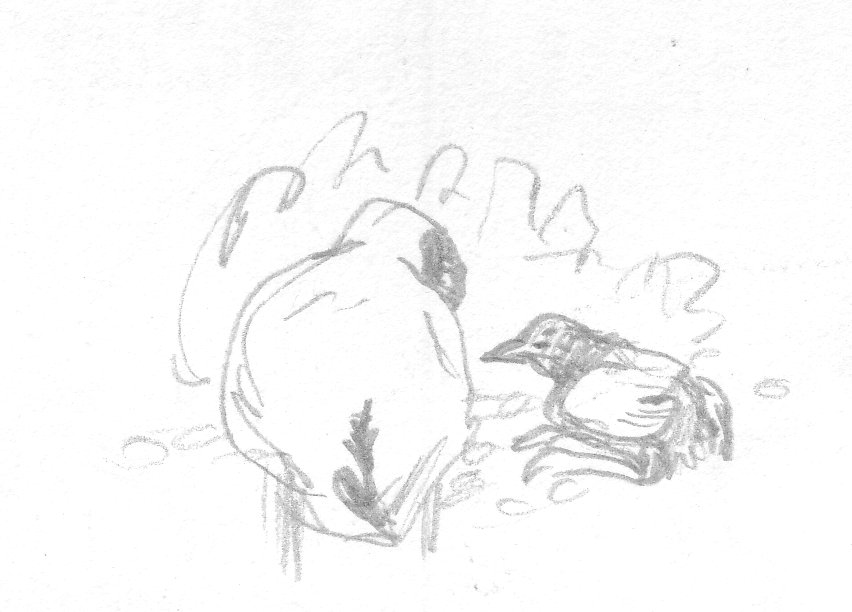
It was raining throughout the visit, but that was ok. When you're in a hide and you're watching nothing but water birds, rain really doesn't effect your birdwatching!
 |
| Getting wet = not a problem! |
But while the adult birds' feathers were keeping them relatively waterproof, the chicks were all still downy and not waterproof at all, leaving their parents with the job of acting as umbrellas for them. This was done by the parent birds holding their wings out from their bodies as far as they could, and the chicks crowding in as closely as possible. It looked like a tight squeeze! It also looked pretty uncomfortable to have wriggly, pointy-beaked chicks stuffed up under your wings.


Two seemed to be the average number of chicks in each family, or sometimes three, but one family that I made particular notes on stood out.

There were a few older chicks that were bigger, had a few body feathers and were roaming further afield, but they were easily intimidated by the noise and fights constantly going on among the adult gulls. I watched as a couple of these 'teenage' chicks accidentally got in the way of a fight among adults, and to get away from it they left the island they were on and hurried out into the lagoon where it was so deep they seemed to be almost swimming! Perhaps they were swimming- adult gulls swim after all.
As time goes by in this colony, I've noticed that more and more Common Terns arrive. They don't nest anywhere on the main lagoon, but a few pairs nest in lagoon behind it that seems less popular with the gull colony, and some more are on special tern nesting islands in the lake next to the lagoons (though Oystercatchers and the odd pair of gulls take up a few of the platforms too). Seeing the terns contrasted with the Black-headed Gulls is always fascinating because it makes the terns look tiny. I think of the Black-headed Gull as small because next to Herring and Lesser Black-backed gulls, it really is. But the Common Tern is much smaller again. In fact all the sea terns, even the bigger Sandwich Terns, are smaller than the Black-headed Gull. Then again, I think I checked it out and found that the smallest sea tern we get in Britain (the tiny Little Tern) is bigger than our most numerous marsh tern! (the Black Tern- I did see some once in constrast to Common Terns and they certainly were weeny.)

4. All grown up (15/6/14) (no sketches this visit)
Now in 2014 again, my latest visit to the colony was in mid-June where I was hoping to see more small chicks. There were still some that were downy, but on the closest islands the babies were larger and almost fully covered with feathers, though they didn't yet have the streamlined shape of the adult birds. A Black-headed Gull's first plumage is a mixture of brown and white, mostly brown but with patches of white that make them look very confusing, at just a glance you're not sure what species you're looking at! If they survive until winter, the chicks will moult into a plumage with much more white, with brown fringing across the wings and a dark band at the end of the tail, like the bird in the photo below.
 |
| This wasn't taken at Titchfield Haven but was actually from winter 2010, in a park in Paris! I know it's random but it makes good reference for this post. I didn't see much wildlife in Paris so probably there won't be a full post about that. ^^ |
Black-headed Gulls won't breed their first summer, and gulls you see in spring and summer that look almost like adults, but with some brown fringing and remnants of the black tail band, are probably always one year old. There were a few of these hanging around in the colony this year, and I found myself wondering if any of them were chicks that I sketched back in 2013! Even if not those specific ones, it seemed likely that they were born at Titchfield Haven, and whatever their reason for hanging around there I expect it will help them when they breed to have been around nesting adults when they were younger!
Sadly on this visit I couldn't check on the status of the reed nesting birds (whether the pair had succeeded in making their 'in-between' nest, etc) because the vegetation in front of the hide had grown so high that I couldn't see low down enough. But I did see something rather gratifying: two families of Moorhens! I didn't see either of their nests but one had some medium sized but still downy babies, and the other had three absolutely tiny babies! The tiny chicks were roaming quite far afield but the adults had a close eye on them, and they stuck to the side of the scrape and well away from any of the islands.
Speaking of meals, I was viewing from another hide (overlooking the neighboring scrape but you can still see what's going on on the large scrape from a distance), when there was a scuffle on the main scrape- a Lesser Black-backed Gull swooped down and targeted a family of Avocets. (there's a few pairs that breed at Titchfield Haven! It's really cool. They tend to breed further from the hides though so it's harder to observe them.) The parent had at least two large chicks, almost as big as her and mostly black and white but still with grey baby feathers on their backs. She was not happy with the gull's proximity to her babies and shooed it off angrily, with a strangely musical alarm call. I couldn't help thinking that her chicks were probably too full grown to be caught by the Lesser but it was impressive to watch! The Lesser didn't give up however, and swooped over to the gull nests, where despite being hounded by the adult Black-headeds, it managed to catch one of the downy chicks. It quickly bore the chick away to the scrape in front of my hide where there were fewer Black-headeds about, and began pecking at the chick and holding it underwater to kill it. A man in the hide who was a regular there told me it had taken 'dozens' of the chicks. But even if it had, and even if it was quite sad to watch, the Lesser Black-backed Gull had a good reason- living, just like any other bird. Any bird species only has to raise enough chicks every year to replace older birds who have died to keep the population stable, and the colony certainly didn't have as many chicks as it did on my visit in 2013 at this later stage, but it's not like there were incredibly few either! And soon the ones that are still downy will be feathered, and too big for the gull to carry off, and it will have to find a new source of food. The mortality rate of course includes first winter deaths, and then more in first summer and second winter, but the ones who survive into their second summer when they are old enough to breed will have already survived a lot, and they will hopefully be equipped to survive a lot more. The oldest recorded Black-headed Gulls have been in their twenties.

Thanks for sticking with me in this odd travel in time, I hope it made sense! I know I will be watching this colony (and sketching it!) for many years to come. It's not only fascinating, but funny! And now whenever I see those common, town dwelling gulls that are Black-headeds, I think about how much they had to go through to get up, because I've seen it happen. Watching common birds on their breeding sites will ensure you never take them for granted again!
Tuesday, 3 June 2014
The mating dance of a non-native species
I'm back! Full disclosure: most of this post was written a few weeks ago, but I was so busy with my costume for MCM ComicCon that I didn't have time to finish it. ^^ But now the con season is over, and I'm back to finish the post, and add an update about how the breeding birds in my area are getting on.
Back a few weeks ago, my mum and I both had a day off, so we decided to go to one of our favourite nature reserves, Titchfield Haven near Fareham. Spring is a wonderful time to visit and watch the thriving Black-headed Gull colony (yes, the one I keep meaning to do a sketchbook post about- next post!) but of course they aren't the only species in the breeding mood. Though I don't think either of us expected to see what we did when we walked along the harbour to the visitor's centre and there were a pair of Black Swans among the Mute Swans, Mallards and Mallard/farmyard duck mixes!
Black Swans are a species from Australia that will definitely never arrive in the UK naturally, but they do escape from wildfowl collections a lot and there are quite a few in the country. Wildfowl collections are prone to escapes because the birds are usually not kept in aviaries, just on ponds with their wings clipped, and this wouldn't be the first time wildfowl from collections have turned up at Titchfield Haven! There's been such fantastic visitors as Fulvous Whistling Duck, Cinnamon Teal, a previous single Black Swan and a Cackling Goose, as well as a Canada Goose thought to be part Bar-headed Goose that was in the reserve's feral goose flock several years ago. The only one of those that might appear naturally in Britain is the Cackling Goose, which resembles a tiny Canada Goose, but it was clear that this one wasn't wild by it's complete lack of shyness as it fed with the Canada Geese a few metres from the hide. I've written a little about escaped ducks in this post where I talk about thinking I saw wild Red-crested Pochards on a village pond when I was about eight...so naive at that age. ^^
Unlike Canada Geese and Mandarin Ducks, Black Swans aren't currently a self-sustaining population, but apparently some are worried they will be the next Canada Geese and sweep the country with large, destructive populations! I don't see that happening, at least not in my lifetime, but according to the staff in the centre there are several feral Black Swans living on the Isle of Wight, a mere skip and a jump over the solent from Titchfield Haven, so that's probably where this pair came from. And as we watched them it became clear that they were thinking about the next generation!
The swans were facing each other with their necks gently curved, making the classic swan's-necks-make-a-heart greetings card pose, and then they began to mimic each other, with one dipping its head under water and back up, and the other doing the same a second later. Then the male moved closer to the female so his breast was touching her side, and looped his neck over her body and into the water on the other side. After he came up he kept his neck draped over her back, and all the time they were making little quiet calls to each other. Then the male slowly began to clamber onto her back so they could mate- actually he climbed on the wrong way round, but she was very patient with him while he slowly and carefully maneuvered his way round to face the same way as her. The actual mating looked a bit difficult and uncomfortable, with her back sinking into the water and him grasping onto the back on her neck with his beak, possibly to help him stay on, but it was over in a second and they broke apart, faced each other, both raised their necks straight up in the air and each gave a loud, triumphant call! You could see the middles of their necks expand out in a comical way while they called. The whole thing was an amazing sight to see, and took place about 5 metres away from the bridge we were watching from. I wished I'd had my camera on me- it's no good for photographing wildlife usually, but they were so close I could certainly have a taken a video of the whole thing!
The Black Swan pair continued to swim together, and later on we saw a Mute Swan pair swim a little too close to them. Suddenly feeling threatened, the Black Swans split up, and each took a Mute Swan to chase, flapping and splashing aggressively and successfully seeing off the bigger swan pair! We wondered if the male chased the male and the female the female, but as Black Swans appear to be sex alike it wasn't possible to tell- I only identified the male in the mating dance from his role. While the male Mute Swan is bigger than the female with a larger lump on his bill, and sometimes holds his wings raised over his back to look bigger, the Black Swans were both the same size, both had the same red bill with a white stripe on it and the same gorgeous, wavy feathers on the base of the back. I've heard Black Swans described as ugly but their plumage certainly isn't- I think it's the rather odd, contrasting bright red beak that gets people. Black Swans have white primary feathers, and I noticed when they flapped at the Mute Swans that at least one of them had no clipping on its wing feathers, suggesting it had moulted at least once since escaping!
Whether or not this pair made a good choice for their nest site, incubate well, and get lucky with the weather and predation (they may well be inexperienced), it was just so fascinating to watch such a natural Spring behaviour as courtship and mating in these captive born birds. I've not seen courtship displays in very many British birds- I've seen Great-Crested Grebes do their beautiful mating dance just once in my entire birdwatching history, and I've seen Buzzards flirting in flight, and Woodpigeons billing and cooing, but there's not many other birds that I can remember watching courting. I did very much enjoy seeing Avocet courtship on Springwatch the other night, though! It involved delicate splashing with the long, beautiful beaks, and then a sort of wing-hug after the actual mating. ^^ Such amazing birds. At some point I will cast my mind back to 2011 and write about the time I saw baby Avocets...
**************************
Speaking of Springwatch, I wrote last time about the baby Blackbirds in our garden, and like Springwatch I am able to give you an update! I was a little concerned to see one baby being fed several times in a row, but this was not a long term problem, and both babies were seen again, getting more confident all the time. What's more, they were joined by a third! Soon the babies were no longer hiding in bushes but were joining the adults on the ground feeder. At first they begged their parents constantly for food, and then they began to peck at the food themselves but only when the parents weren't around. As soon as a parent would appear, the babies would completely forget about their newfound feeding independence and beg shamelessly, opening their still visible gapes and peeping and wing-fluttering..it was quite hilarious to watch, and the poor parents were so frazzled!
Blackbirds have multiple broods, and it didn't take long for the female to stop attending the babies at all, as she was no doubt concentrating on brewing the next clutch of eggs, and probably renewing and strengthening the nest after the strain of having had three large babies wriggling about in it. When it comes to feeding, impressively she sometimes uses one of our sunflower heart feeders! Thrushes are not really built for feeders, but she can stay hanging on long enough to gulp a few down. The sunflower hearts also proved a good meal for the babies as they began to feed themselves in earnest, as they were able to peck up all the seeds the messy finches are always dropping. The male was still around keeping an eye on the babies in a sort of hands-off way, and though they still pestered him for food when he was around and he'd sometimes feed them out of habit, they were really almost fully independent. They were flying properly, their tails were almost full length (if a little wonky and scruffy), and their gapes were almost gone.
It was just about at this point when another baby Blackbird appeared in the garden! This one was a really young one, with the tiny tail, speckley breast and giant yellow gape. The female of the first brood was still absent most of the time, probably incubating her second brood, so this wasn't the original Blackbird pair's baby but from a new brood, and a different pair! It was really funny seeing the contrast between the slightly older babies and the new one.
Next baby bird to appear was a young Starling, joining the adults on the ground feeder. I'd been looking forward to seeing the first baby Starlings ever since I found the eggshells I wrote about last time, and was so happy when the day finally arrived! The juvenile Starling didn't have the scruffy feathers the baby Blackbirds had, but was just as slim and streamlined as the adults, though light grey all over. I couldn't see any external gape, and its begging technique was different from the baby Blackbirds- it didn't flutter or peep, but just sat there with its great, gaping beak open while the adults stuffed in food! Its beak was bright yellowy-orange on the inside. There were at least 3 adults on the ground feeder with the baby so it wasn't just with its parents, but none of the adults seemed at all worried about each others' presence or the baby's presence, showing the Starlings truly are flock birds, even in the breeding season. This is in stark contrast to Blackbirds, who don't flock in the breeding season, and in fact the father of the first Blackbird babies got into a rather violent scuffle with another Blackbird (probably the father of the second Blackbird babies as I doubt there's room for any more Blackbirds around here!). It was a proper pecking, rolling around and clawing fight and something I've never seen. It was hard to tell who won, but 'our' Blackbird (the father of the first babies) has been looking a bit worse for wear every since, as he lost a whole chunk of the feathers on his forehead. A few weeks later, he's still like that, but now the poor guy has also had an encounter with (probably) a cat, which cost him all of his tail feathers! It's sad to see him wagging his behind automatically, and having no tail to flourish proudly. The moulting season is coming up anyway, though, so he should soon be growing new ones. And until then there's plenty of food about.
Next to appear was an adorable baby Robin, and two scruffy baby Dunnocks (they have pink beaks! It's weird). Then a couple of weeks ago, there were yet more baby birds in the form of a beautiful (and HUNGRY) Great Tit family, and then the Goldfinches were next, with three beige-faced youngsters watching the adults on the feeder and begging shamelessly for food. Young Goldfinches may not have the black, white and red face pattern of the adults but they already have the yellow wing bars that makes Goldfinches so distinctive. Young Great Tits have the same pattern as the adults but they have yellow cheeks, as do young Blue Tits. When I was younger I saw a picture of this in a bird book and was surprised to see that the youngsters seemed even more colourful than the adults which didn't seem a good idea for baby birds, but when you actually see them the effect of the yellow is to tone down the contrast on the head pattern, turning black and white into black and pale yellow. This, combined with an overall 'desaturation' of the colour on the rest of the feathers means they are far less noticeable than the adults. We don't think either of these species nested in the garden or all that close to it, but we're glad they came to our garden to feed their hungry young. :) Goldfinches are everyday visitors to the feeders, but before the babies came the Great Tit was seen only occasionally this Spring, usually in the evening when it would stop by for a quick bite to eat at the feeder.
And this evening, I looked out of the window and saw tiny, ball-shaped birds whizzing around the garden- it was a Wren family! The babies perched in our hedgerow and wildflower area, occasionally fluttering from bush, whirring their little stumpy wings at top speed. Despite their tiny size the yellow gape at the edges of their beaks was very visible. We counted three young attended by one adult, who by contrast looked very sleek and confident as it balanced expertly on small stems to pick little insects from under the leaves.
At my local patch, I've seen baby Robins (out on their own) and a baby Great Tit (fiercely attended by a noisy adult with an extremely wide black belly stripe!), and best of all, last visit there were three young Long-tailed Tits! I couldn't see an adult and they seemed pretty much independent, and they already had full-length tails, but the big smudge of black over their eyes gave them away. It really emphasised the orange eyes Long-tailed Tits have. I've found Robin eggshells and, more unusually, the vivid bright blue of a Song Thrush eggshell. Song Thrushes aren't unusual of course but I rarely ever see them on my patch, or hear them, with the only singing male I've heard there coming from far away, possibly from a garden on one of the suburban estates at the edge of my small arable farm patch. In my egg post I talk about the Starlings dropping their hatched eggshells away from the nest, so maybe a thrush flew all the way in from a neighbouring garden to really throw predators off the scent?
The male Whitethroat is back in his usual singing spot, and the male Yellowhammer is singing in the hedgerow, both familiar from last year (this is only my second Spring watching this patch) but there's a new player in the form of a lovely Goldfinch pair who I suspect are nesting in the shrubs below the mature trees in the middle of the farm. The Skylarks are hovering and landing on the fields a lot, and it's exciting to think that somewhere in the sea of green crop are hidden eggs. The Carrion Crow pair are back in the same patch of trees as last year, but not in the nest I found last year, which I suspect blew apart in the winter storms. They have a new one, more deeply hidden in the trees, and now both members of the pair are flying around again which I suspect means the babies have hatched! There's a Jackdaw pair around that area, and a Magpie pair in the trees at the edge of the farm.
Finally, the House Martins, who nest in the area but not in the actual patch (perhaps on the estate too), are visiting their favourite mud puddle on one of the paths to pick up mud for their nests. At one point I counted 17 landing there all at once! I always hope that I'll see their tiny footprints and beak marks in the mud, but I haven't yet. They are extremely light, after all!
How is the breeding season shaping up in your area? Are there baby birds in your garden, or at your patch? Tell me all about them! :)
Back a few weeks ago, my mum and I both had a day off, so we decided to go to one of our favourite nature reserves, Titchfield Haven near Fareham. Spring is a wonderful time to visit and watch the thriving Black-headed Gull colony (yes, the one I keep meaning to do a sketchbook post about- next post!) but of course they aren't the only species in the breeding mood. Though I don't think either of us expected to see what we did when we walked along the harbour to the visitor's centre and there were a pair of Black Swans among the Mute Swans, Mallards and Mallard/farmyard duck mixes!
Black Swans are a species from Australia that will definitely never arrive in the UK naturally, but they do escape from wildfowl collections a lot and there are quite a few in the country. Wildfowl collections are prone to escapes because the birds are usually not kept in aviaries, just on ponds with their wings clipped, and this wouldn't be the first time wildfowl from collections have turned up at Titchfield Haven! There's been such fantastic visitors as Fulvous Whistling Duck, Cinnamon Teal, a previous single Black Swan and a Cackling Goose, as well as a Canada Goose thought to be part Bar-headed Goose that was in the reserve's feral goose flock several years ago. The only one of those that might appear naturally in Britain is the Cackling Goose, which resembles a tiny Canada Goose, but it was clear that this one wasn't wild by it's complete lack of shyness as it fed with the Canada Geese a few metres from the hide. I've written a little about escaped ducks in this post where I talk about thinking I saw wild Red-crested Pochards on a village pond when I was about eight...so naive at that age. ^^
Unlike Canada Geese and Mandarin Ducks, Black Swans aren't currently a self-sustaining population, but apparently some are worried they will be the next Canada Geese and sweep the country with large, destructive populations! I don't see that happening, at least not in my lifetime, but according to the staff in the centre there are several feral Black Swans living on the Isle of Wight, a mere skip and a jump over the solent from Titchfield Haven, so that's probably where this pair came from. And as we watched them it became clear that they were thinking about the next generation!
The swans were facing each other with their necks gently curved, making the classic swan's-necks-make-a-heart greetings card pose, and then they began to mimic each other, with one dipping its head under water and back up, and the other doing the same a second later. Then the male moved closer to the female so his breast was touching her side, and looped his neck over her body and into the water on the other side. After he came up he kept his neck draped over her back, and all the time they were making little quiet calls to each other. Then the male slowly began to clamber onto her back so they could mate- actually he climbed on the wrong way round, but she was very patient with him while he slowly and carefully maneuvered his way round to face the same way as her. The actual mating looked a bit difficult and uncomfortable, with her back sinking into the water and him grasping onto the back on her neck with his beak, possibly to help him stay on, but it was over in a second and they broke apart, faced each other, both raised their necks straight up in the air and each gave a loud, triumphant call! You could see the middles of their necks expand out in a comical way while they called. The whole thing was an amazing sight to see, and took place about 5 metres away from the bridge we were watching from. I wished I'd had my camera on me- it's no good for photographing wildlife usually, but they were so close I could certainly have a taken a video of the whole thing!
The Black Swan pair continued to swim together, and later on we saw a Mute Swan pair swim a little too close to them. Suddenly feeling threatened, the Black Swans split up, and each took a Mute Swan to chase, flapping and splashing aggressively and successfully seeing off the bigger swan pair! We wondered if the male chased the male and the female the female, but as Black Swans appear to be sex alike it wasn't possible to tell- I only identified the male in the mating dance from his role. While the male Mute Swan is bigger than the female with a larger lump on his bill, and sometimes holds his wings raised over his back to look bigger, the Black Swans were both the same size, both had the same red bill with a white stripe on it and the same gorgeous, wavy feathers on the base of the back. I've heard Black Swans described as ugly but their plumage certainly isn't- I think it's the rather odd, contrasting bright red beak that gets people. Black Swans have white primary feathers, and I noticed when they flapped at the Mute Swans that at least one of them had no clipping on its wing feathers, suggesting it had moulted at least once since escaping!
Whether or not this pair made a good choice for their nest site, incubate well, and get lucky with the weather and predation (they may well be inexperienced), it was just so fascinating to watch such a natural Spring behaviour as courtship and mating in these captive born birds. I've not seen courtship displays in very many British birds- I've seen Great-Crested Grebes do their beautiful mating dance just once in my entire birdwatching history, and I've seen Buzzards flirting in flight, and Woodpigeons billing and cooing, but there's not many other birds that I can remember watching courting. I did very much enjoy seeing Avocet courtship on Springwatch the other night, though! It involved delicate splashing with the long, beautiful beaks, and then a sort of wing-hug after the actual mating. ^^ Such amazing birds. At some point I will cast my mind back to 2011 and write about the time I saw baby Avocets...
**************************
Speaking of Springwatch, I wrote last time about the baby Blackbirds in our garden, and like Springwatch I am able to give you an update! I was a little concerned to see one baby being fed several times in a row, but this was not a long term problem, and both babies were seen again, getting more confident all the time. What's more, they were joined by a third! Soon the babies were no longer hiding in bushes but were joining the adults on the ground feeder. At first they begged their parents constantly for food, and then they began to peck at the food themselves but only when the parents weren't around. As soon as a parent would appear, the babies would completely forget about their newfound feeding independence and beg shamelessly, opening their still visible gapes and peeping and wing-fluttering..it was quite hilarious to watch, and the poor parents were so frazzled!
Blackbirds have multiple broods, and it didn't take long for the female to stop attending the babies at all, as she was no doubt concentrating on brewing the next clutch of eggs, and probably renewing and strengthening the nest after the strain of having had three large babies wriggling about in it. When it comes to feeding, impressively she sometimes uses one of our sunflower heart feeders! Thrushes are not really built for feeders, but she can stay hanging on long enough to gulp a few down. The sunflower hearts also proved a good meal for the babies as they began to feed themselves in earnest, as they were able to peck up all the seeds the messy finches are always dropping. The male was still around keeping an eye on the babies in a sort of hands-off way, and though they still pestered him for food when he was around and he'd sometimes feed them out of habit, they were really almost fully independent. They were flying properly, their tails were almost full length (if a little wonky and scruffy), and their gapes were almost gone.
It was just about at this point when another baby Blackbird appeared in the garden! This one was a really young one, with the tiny tail, speckley breast and giant yellow gape. The female of the first brood was still absent most of the time, probably incubating her second brood, so this wasn't the original Blackbird pair's baby but from a new brood, and a different pair! It was really funny seeing the contrast between the slightly older babies and the new one.
Next baby bird to appear was a young Starling, joining the adults on the ground feeder. I'd been looking forward to seeing the first baby Starlings ever since I found the eggshells I wrote about last time, and was so happy when the day finally arrived! The juvenile Starling didn't have the scruffy feathers the baby Blackbirds had, but was just as slim and streamlined as the adults, though light grey all over. I couldn't see any external gape, and its begging technique was different from the baby Blackbirds- it didn't flutter or peep, but just sat there with its great, gaping beak open while the adults stuffed in food! Its beak was bright yellowy-orange on the inside. There were at least 3 adults on the ground feeder with the baby so it wasn't just with its parents, but none of the adults seemed at all worried about each others' presence or the baby's presence, showing the Starlings truly are flock birds, even in the breeding season. This is in stark contrast to Blackbirds, who don't flock in the breeding season, and in fact the father of the first Blackbird babies got into a rather violent scuffle with another Blackbird (probably the father of the second Blackbird babies as I doubt there's room for any more Blackbirds around here!). It was a proper pecking, rolling around and clawing fight and something I've never seen. It was hard to tell who won, but 'our' Blackbird (the father of the first babies) has been looking a bit worse for wear every since, as he lost a whole chunk of the feathers on his forehead. A few weeks later, he's still like that, but now the poor guy has also had an encounter with (probably) a cat, which cost him all of his tail feathers! It's sad to see him wagging his behind automatically, and having no tail to flourish proudly. The moulting season is coming up anyway, though, so he should soon be growing new ones. And until then there's plenty of food about.
Next to appear was an adorable baby Robin, and two scruffy baby Dunnocks (they have pink beaks! It's weird). Then a couple of weeks ago, there were yet more baby birds in the form of a beautiful (and HUNGRY) Great Tit family, and then the Goldfinches were next, with three beige-faced youngsters watching the adults on the feeder and begging shamelessly for food. Young Goldfinches may not have the black, white and red face pattern of the adults but they already have the yellow wing bars that makes Goldfinches so distinctive. Young Great Tits have the same pattern as the adults but they have yellow cheeks, as do young Blue Tits. When I was younger I saw a picture of this in a bird book and was surprised to see that the youngsters seemed even more colourful than the adults which didn't seem a good idea for baby birds, but when you actually see them the effect of the yellow is to tone down the contrast on the head pattern, turning black and white into black and pale yellow. This, combined with an overall 'desaturation' of the colour on the rest of the feathers means they are far less noticeable than the adults. We don't think either of these species nested in the garden or all that close to it, but we're glad they came to our garden to feed their hungry young. :) Goldfinches are everyday visitors to the feeders, but before the babies came the Great Tit was seen only occasionally this Spring, usually in the evening when it would stop by for a quick bite to eat at the feeder.
And this evening, I looked out of the window and saw tiny, ball-shaped birds whizzing around the garden- it was a Wren family! The babies perched in our hedgerow and wildflower area, occasionally fluttering from bush, whirring their little stumpy wings at top speed. Despite their tiny size the yellow gape at the edges of their beaks was very visible. We counted three young attended by one adult, who by contrast looked very sleek and confident as it balanced expertly on small stems to pick little insects from under the leaves.
At my local patch, I've seen baby Robins (out on their own) and a baby Great Tit (fiercely attended by a noisy adult with an extremely wide black belly stripe!), and best of all, last visit there were three young Long-tailed Tits! I couldn't see an adult and they seemed pretty much independent, and they already had full-length tails, but the big smudge of black over their eyes gave them away. It really emphasised the orange eyes Long-tailed Tits have. I've found Robin eggshells and, more unusually, the vivid bright blue of a Song Thrush eggshell. Song Thrushes aren't unusual of course but I rarely ever see them on my patch, or hear them, with the only singing male I've heard there coming from far away, possibly from a garden on one of the suburban estates at the edge of my small arable farm patch. In my egg post I talk about the Starlings dropping their hatched eggshells away from the nest, so maybe a thrush flew all the way in from a neighbouring garden to really throw predators off the scent?
The male Whitethroat is back in his usual singing spot, and the male Yellowhammer is singing in the hedgerow, both familiar from last year (this is only my second Spring watching this patch) but there's a new player in the form of a lovely Goldfinch pair who I suspect are nesting in the shrubs below the mature trees in the middle of the farm. The Skylarks are hovering and landing on the fields a lot, and it's exciting to think that somewhere in the sea of green crop are hidden eggs. The Carrion Crow pair are back in the same patch of trees as last year, but not in the nest I found last year, which I suspect blew apart in the winter storms. They have a new one, more deeply hidden in the trees, and now both members of the pair are flying around again which I suspect means the babies have hatched! There's a Jackdaw pair around that area, and a Magpie pair in the trees at the edge of the farm.
Finally, the House Martins, who nest in the area but not in the actual patch (perhaps on the estate too), are visiting their favourite mud puddle on one of the paths to pick up mud for their nests. At one point I counted 17 landing there all at once! I always hope that I'll see their tiny footprints and beak marks in the mud, but I haven't yet. They are extremely light, after all!
How is the breeding season shaping up in your area? Are there baby birds in your garden, or at your patch? Tell me all about them! :)
Thursday, 23 January 2014
Amorous Activities in the Pigeon Family
This is sort of a continuation to my last post about early signs of Spring caused by the mild winter, but only sort of, as hopefully I will show! On a walk about a week ago, I found this:

This is a Woodpigeon's egg, which has been predated. If it had hatched naturally it would have broken into two halves due to the way a baby bird pecks around an egg to escape it using its egg-tooth. And according to my trusty Helm Identification Guide 'Tracks & Signs of the Birds of Britain and Europe', a predator such as a weasel would smash the whole egg up when it ate it. The hole in this otherwise intact eggshell shows that it was predated by a bird, such as a corvid.
The reason I said that this is only sort of a sign of early Spring is that Woodpigeons (and other pigeon species such as Collared Dove) are known to breed at all times of year. They can do this because, unlike most passerines, they can regurgitate food to feed to their babies in a substance known as pigeon milk, meaning as long as there's food for the adults there's food for the babies. Other species of birds, such as Blue Tits, need soft food such as caterpillars and insects for their babies, so they have to breed at the right time of year for that food.
However, weather still matters and I doubt Woodpigeons would have been breeding last January. It was just too cold. And even with this year's mild winter, if this egg hadn't been predated I wouldn't have expected it to survive. Woodpigeons build very basic nests of just a few twigs in a tree, and it's been SO windy and rainy this winter that the nest would have probably blown down.
Speaking of breeding behaviour in the pigeon family, today I was looking out into my garden and saw a pair of Collared Doves start mating! Then, as if that wasn't enough, only a few minutes later there was a pair of Woodpigeons who also began to mate, but this time I got the chance to see a little bit of their courtship too. What first drew my attention was one pigeon began pecking at the beak of the other, and then stuck its beak right inside the other's; it was being fed on pigeon milk! I'd never seen anything like it before. I guessed the one doing the feeding must have been the male, and sure enough when they began to mate it was this bird that jumped on top. Before mating they sort of snuggled up together, with the male puffing up his breast feathers to look bigger.
I've talked about courtship feeding before, and how I've seen females in both Blue Tits and Carrion Crows use a wing-fluttering display to show they want to be fed by the male. The female pecking the male's beak was different though, and reminded me more of the Herring Gull chicks when they pecked their parent's beak on the red pecking spot to get them to regurgitate. Only in the case of the adult Herring Gulls, they were regurgitating a large lump of food onto the ground for the chicks, while the Woodpigeon behaviour I saw suggests that their young take food straight from the parents' beaks. Well, the name 'pigeon milk' does suggest liquid! The male Woodpigeon was showing the female how well he'd be able to feed babies when it came to the time, as well as how well he would feed the female while she was laying and incubating. It looks like more eggs are coming in the future, so let's hope we don't get any more storms!
Woodpigeons are such fascinating birds to watch, especially as you can often observe their behaviour very closely when they are in gardens and parks. We have a ground feeder in our garden and I've noticed how dominant Woodpigeons have a sort of 'lurch forward and wing-flap' gesture that they do to scare off other birds feeding on it. Or at least, it's supposed to! It works on other Woodpigeons and on Collared Doves; they all back off. But Starlings tend to ignore the gesture completely! Starlings may be a good bit smaller than pigeons but they aren't easily intimidated. And perhaps pigeon body language doesn't translate well outside the family?
I hope I'll have the chance to write more about Woodpigeons in the future, because I've seen all kinds of interesting interactions among them. I've seen them squaring up, bowing to each other, standing up as tall as possible, mimicking each other's behaviour...what do these behaviours mean? To guess at that I'd need to watch them more closely, which I plan to do in the future. Since writing this blog I've started watching bird behaviour more closely than ever before, and I feel like I'm finding out new things all the time! As always, please do submit stories of your own about bird behaviour- have you seen any pigeon courtship this winter? If so, leave me comment and tell me all about it! :)
**************************
This is unrelated to pigeons, but on the same walk that I found that eggshell, I saw this:

On the left is a small animal hole (I'd say the photo is about actual size), and in the middle and bottom you can see the shells of seeds. I don't know what species lives here but I'm sure its either a mouse or a vole, as they both eat seeds. Leaving all the seed shells outside reminds me a bit of our hamster, who tends to spit his empty shells outside of his bed! Of course a small animal that lives in a hole doesn't really need to hide its seed shells, as it is safe inside and the hole is so obvious anyway.
**************************
And finally, and back on the pigeons, here's a slightly disturbing pop cultural reference to pigeon milk! I'm a big fan of the game series Animal Crossing, in which there's a pigeon character named the Brewster who owns a coffee shop. After you get to know him a bit, he offers you some pigeon milk to put in your coffee. Um........:O
Someone in this game's development had a sense of humour alright!
...But as you can see from the picture, in the game your character seems to really enjoy the pigeon milk-infused coffee. So I guess it's not so bad!
This is a Woodpigeon's egg, which has been predated. If it had hatched naturally it would have broken into two halves due to the way a baby bird pecks around an egg to escape it using its egg-tooth. And according to my trusty Helm Identification Guide 'Tracks & Signs of the Birds of Britain and Europe', a predator such as a weasel would smash the whole egg up when it ate it. The hole in this otherwise intact eggshell shows that it was predated by a bird, such as a corvid.
The reason I said that this is only sort of a sign of early Spring is that Woodpigeons (and other pigeon species such as Collared Dove) are known to breed at all times of year. They can do this because, unlike most passerines, they can regurgitate food to feed to their babies in a substance known as pigeon milk, meaning as long as there's food for the adults there's food for the babies. Other species of birds, such as Blue Tits, need soft food such as caterpillars and insects for their babies, so they have to breed at the right time of year for that food.
However, weather still matters and I doubt Woodpigeons would have been breeding last January. It was just too cold. And even with this year's mild winter, if this egg hadn't been predated I wouldn't have expected it to survive. Woodpigeons build very basic nests of just a few twigs in a tree, and it's been SO windy and rainy this winter that the nest would have probably blown down.
Speaking of breeding behaviour in the pigeon family, today I was looking out into my garden and saw a pair of Collared Doves start mating! Then, as if that wasn't enough, only a few minutes later there was a pair of Woodpigeons who also began to mate, but this time I got the chance to see a little bit of their courtship too. What first drew my attention was one pigeon began pecking at the beak of the other, and then stuck its beak right inside the other's; it was being fed on pigeon milk! I'd never seen anything like it before. I guessed the one doing the feeding must have been the male, and sure enough when they began to mate it was this bird that jumped on top. Before mating they sort of snuggled up together, with the male puffing up his breast feathers to look bigger.
I've talked about courtship feeding before, and how I've seen females in both Blue Tits and Carrion Crows use a wing-fluttering display to show they want to be fed by the male. The female pecking the male's beak was different though, and reminded me more of the Herring Gull chicks when they pecked their parent's beak on the red pecking spot to get them to regurgitate. Only in the case of the adult Herring Gulls, they were regurgitating a large lump of food onto the ground for the chicks, while the Woodpigeon behaviour I saw suggests that their young take food straight from the parents' beaks. Well, the name 'pigeon milk' does suggest liquid! The male Woodpigeon was showing the female how well he'd be able to feed babies when it came to the time, as well as how well he would feed the female while she was laying and incubating. It looks like more eggs are coming in the future, so let's hope we don't get any more storms!
Woodpigeons are such fascinating birds to watch, especially as you can often observe their behaviour very closely when they are in gardens and parks. We have a ground feeder in our garden and I've noticed how dominant Woodpigeons have a sort of 'lurch forward and wing-flap' gesture that they do to scare off other birds feeding on it. Or at least, it's supposed to! It works on other Woodpigeons and on Collared Doves; they all back off. But Starlings tend to ignore the gesture completely! Starlings may be a good bit smaller than pigeons but they aren't easily intimidated. And perhaps pigeon body language doesn't translate well outside the family?
I hope I'll have the chance to write more about Woodpigeons in the future, because I've seen all kinds of interesting interactions among them. I've seen them squaring up, bowing to each other, standing up as tall as possible, mimicking each other's behaviour...what do these behaviours mean? To guess at that I'd need to watch them more closely, which I plan to do in the future. Since writing this blog I've started watching bird behaviour more closely than ever before, and I feel like I'm finding out new things all the time! As always, please do submit stories of your own about bird behaviour- have you seen any pigeon courtship this winter? If so, leave me comment and tell me all about it! :)
**************************
This is unrelated to pigeons, but on the same walk that I found that eggshell, I saw this:
On the left is a small animal hole (I'd say the photo is about actual size), and in the middle and bottom you can see the shells of seeds. I don't know what species lives here but I'm sure its either a mouse or a vole, as they both eat seeds. Leaving all the seed shells outside reminds me a bit of our hamster, who tends to spit his empty shells outside of his bed! Of course a small animal that lives in a hole doesn't really need to hide its seed shells, as it is safe inside and the hole is so obvious anyway.
**************************
And finally, and back on the pigeons, here's a slightly disturbing pop cultural reference to pigeon milk! I'm a big fan of the game series Animal Crossing, in which there's a pigeon character named the Brewster who owns a coffee shop. After you get to know him a bit, he offers you some pigeon milk to put in your coffee. Um........:O
Someone in this game's development had a sense of humour alright!
 |
| Source: http://soapboxview.blogspot.co.uk/2013/08/the-animal-crossing-new-leaf-photo-post.html |
...But as you can see from the picture, in the game your character seems to really enjoy the pigeon milk-infused coffee. So I guess it's not so bad!
Tuesday, 14 January 2014
Early Signs of Things to Come!
It's been a milder winter than the past few we've had, and though the nights are starting to get a little frosty it's certainly nothing like last year! This time last year I'd already seen my local patch turn into a snowy wonderland, with unexpected visitors (a huge flock of Lapwings and a smaller one of Golden Plovers!), and my garden was awash with colour as Bramblings and Siskins mingled with the Goldfinches, Chaffinches and Greenfinches! This year the winter finches have yet to arrive, if they will at all (though we have had some small flocks of Redwings visiting, and the odd Fieldfare!). At my patch, the stubble fields are covered with flocks of Redwings, Fieldfares, Skylarks and Chaffinches. I don't remember ever seeing so many birds feeding on them!
The mild weather has meant that I've been hearing and seeing more signs of Spring everywhere, and though I know we may still get a cold snap it is certainly interesting to see how the birds and plants are behaving. Birds are singing, bulbs are sprouting, catkins are on the trees. In December and early January I heard a Great Tit singing, saw two Robins in the same personal space without a fight (a sure sign of a potential pair!), and heard a Skylark in song-flight, though his song was not as advanced and detailed as it will be in a month or so. Meanwhile a Blue Tit has been thoroughly checking out our garden nest box, mostly perching outside and looking in but popping in a couple of times too. I've seen Black-headed Gulls whose heads are almost completely brown again (the name is a misnomer, the head is chocolate brown!), while some are still in their winter plumage. I wonder what causes the difference?
My garden is part of the territory of a male Song Thrush, who has been singing every morning and evening since before Christmas. Sometimes he's outside the garden, though the distinctive, repeating song is far-carrying and can always be heard clearly, but when he's in the garden I've been able to get some sketches. This one is from December.
 He sits at the top of the willow tree and sings his little speckled heart out. As you can see from my fanciful notes, an I think female Blackbird was sitting nearby and seemed to be listening! But who knows what was really going on.
This one was from the 6th of January at about 4:30pm.

I watched him hop up the tree, making a few song notes, before choosing a good spot to sing, not quite at the top of the tree this time but near it. He began to sing, turning his body every half minute or so to aim his song in different directions. One thing's for sure; male Song Thrushes in the area will know for sure that this territory is Taken! He moved out of the garden after about 10 minutes, but he continued to sing elsewhere.
As I mentioned in my New Years post, I recently heard a Grey Wagtail sing for the first time-that was this winter too! I was watching a watercress bed in Alresford when a Grey Wagtail landed on it and began to hop about. Soon it began to sing, while still perched on the ground (which makes sense as Grey Wagtails spend most of their time on the ground, but how many birds sing from the ground out in the open? Most sing from a tree, from cover, or from flight, so it was unexpected for me, especially as I hadn't realised Grey Wagtails even had a song!). Then another Grey Wagtail suddenly appeared and shooed the singer away! Both birds had white throats, which adult winter Grey Wagtails all have (while breeding males have black throats) but for most birds (except a few Black-headed Gulls apparently!) it's far too early to be in breeding plumage, so I suspect these birds were both male, and the second bird already owned the territory and was making that clear to the singing bird. Though anyone who knows more about Grey Wagtail behaviour, please do comment and correct me! There may be something I don't know about female behaviour.
Just before the end of last year, I also saw courtship behaviour in Nuthatches for the first time! I spotted two Nuthatches up in a tree, and then noticed that one was pursuing the other, up and down the trunk and from tree to tree. Then one bird began to dip its head exaggeratedly (but considering how big a Nuthatch's head is compared to it's body, most things it does with it seem exaggerated!) while the other bird started to wing-flutter, like a baby bird does when it wants to be fed. I've written about this behaviour before, in both Blue Tits and Carrion Crows, and how it is a commonly seen courtship behaviour in female birds, so it was clear that this was a female and the head-dipping and chasing bird was the male. He then began to sing- Nuthatches have such a strange song, if you ever hear something that sounds like a car alarm going off in a wood, it'll probably be a Nuthatch singing!
These birds are probably not planning on making nests just yet, but they are establishing pair bonds, territories and nest sites, so they can be all ready for when it really is the breeding season! If you have also seen or heard birds or other wildlife doing these behaviours, please write me a comment and tell me all about it! :) Meanwhile, here's a post from Chris R, also based in Hampshire, about noticing birdsong, woodpecker drumming, Buzzard courtship behaviour (which sounds similar to what I described at the end of this post), and honeybee activity this new year: http://fourmarksbirding.blogspot.co.uk/2014/01/11th-january-and-i-say-its-all-right.html Enjoy!
The mild weather has meant that I've been hearing and seeing more signs of Spring everywhere, and though I know we may still get a cold snap it is certainly interesting to see how the birds and plants are behaving. Birds are singing, bulbs are sprouting, catkins are on the trees. In December and early January I heard a Great Tit singing, saw two Robins in the same personal space without a fight (a sure sign of a potential pair!), and heard a Skylark in song-flight, though his song was not as advanced and detailed as it will be in a month or so. Meanwhile a Blue Tit has been thoroughly checking out our garden nest box, mostly perching outside and looking in but popping in a couple of times too. I've seen Black-headed Gulls whose heads are almost completely brown again (the name is a misnomer, the head is chocolate brown!), while some are still in their winter plumage. I wonder what causes the difference?
My garden is part of the territory of a male Song Thrush, who has been singing every morning and evening since before Christmas. Sometimes he's outside the garden, though the distinctive, repeating song is far-carrying and can always be heard clearly, but when he's in the garden I've been able to get some sketches. This one is from December.

This one was from the 6th of January at about 4:30pm.

I watched him hop up the tree, making a few song notes, before choosing a good spot to sing, not quite at the top of the tree this time but near it. He began to sing, turning his body every half minute or so to aim his song in different directions. One thing's for sure; male Song Thrushes in the area will know for sure that this territory is Taken! He moved out of the garden after about 10 minutes, but he continued to sing elsewhere.
As I mentioned in my New Years post, I recently heard a Grey Wagtail sing for the first time-that was this winter too! I was watching a watercress bed in Alresford when a Grey Wagtail landed on it and began to hop about. Soon it began to sing, while still perched on the ground (which makes sense as Grey Wagtails spend most of their time on the ground, but how many birds sing from the ground out in the open? Most sing from a tree, from cover, or from flight, so it was unexpected for me, especially as I hadn't realised Grey Wagtails even had a song!). Then another Grey Wagtail suddenly appeared and shooed the singer away! Both birds had white throats, which adult winter Grey Wagtails all have (while breeding males have black throats) but for most birds (except a few Black-headed Gulls apparently!) it's far too early to be in breeding plumage, so I suspect these birds were both male, and the second bird already owned the territory and was making that clear to the singing bird. Though anyone who knows more about Grey Wagtail behaviour, please do comment and correct me! There may be something I don't know about female behaviour.
Just before the end of last year, I also saw courtship behaviour in Nuthatches for the first time! I spotted two Nuthatches up in a tree, and then noticed that one was pursuing the other, up and down the trunk and from tree to tree. Then one bird began to dip its head exaggeratedly (but considering how big a Nuthatch's head is compared to it's body, most things it does with it seem exaggerated!) while the other bird started to wing-flutter, like a baby bird does when it wants to be fed. I've written about this behaviour before, in both Blue Tits and Carrion Crows, and how it is a commonly seen courtship behaviour in female birds, so it was clear that this was a female and the head-dipping and chasing bird was the male. He then began to sing- Nuthatches have such a strange song, if you ever hear something that sounds like a car alarm going off in a wood, it'll probably be a Nuthatch singing!
These birds are probably not planning on making nests just yet, but they are establishing pair bonds, territories and nest sites, so they can be all ready for when it really is the breeding season! If you have also seen or heard birds or other wildlife doing these behaviours, please write me a comment and tell me all about it! :) Meanwhile, here's a post from Chris R, also based in Hampshire, about noticing birdsong, woodpecker drumming, Buzzard courtship behaviour (which sounds similar to what I described at the end of this post), and honeybee activity this new year: http://fourmarksbirding.blogspot.co.uk/2014/01/11th-january-and-i-say-its-all-right.html Enjoy!
Sunday, 5 May 2013
The Crow's Nest
Spring has finally come, and my local patch is showing all the signs- loads of Skylarks singing, leaves popping out all over the trees and blackthorn blossom in the hedges, the first butterflies fluttering, plus the farmer's horrible oilseed rape field has bloomed and is wrecking havoc with my hayfever... yay for spring! My local patch is the site I watch wildlife at the most, I visit it once a week and record all birds seen on Birdtrack, the BTO's bird recording tool that helps them determine numbers of all species. It's a small arable farm, and doesn't have a particularly high species density, so everything I see there feels special.
All the species I see regularly are singing, or at least calling if they aren't really singers (Woodpigeons, I'm looking at you!) and I have been looking out for signs of nest building. I'm not sure many of the small birds are at the sitting on eggs stage yet, as they are still being seen in pairs, but one nest is definitely at that stage. My patch has a regular pair of Carrion Crows that are seen on practically every visit, feeding on the fields. Last Sunday I could only see one on the field, which was unusual, but then later I heard the sound of a crow calling from the top of a tree. Looking up, I could see a large bundle of sticks, and over the edge of it a tail could be seen. It was an occupied crow's nest!
I watched the male crow feeding on the field margin, and wondered if he was going to bring food to the female on the nest, but he seemed to be swallowing what he was finding. Then he flew a short distance along the field, and I noticed that the female was now on the field margin, and the male had been flying to her. She began to flutter her wings, then he put his beak to hers and regurgitated food for her. The wing fluttering is a gesture you usually see from newly fledged baby birds who want feeding, but in the breeding season you often see female birds doing it and receiving food from the male as a form of courtship and pair bonding. I have wondered whether the wing fluttering is just an understood begging gesture or if it is supposed to remind the male of baby birds to get him in the reproductive mood! Nature is very practical, after all. And I have heard female Blue Tits that are doing the begging gesture give quiet high-pitched calls that are quite unlike their normal contact call, as if they are imitating the sound of baby birds chirping. But I have no idea if my theory is on the right track.
I should think the male feeding the female was more for pair bonding than actual feeding, because they both fed on the field margin for 10 minutes or so before the female flew back to the nest. Incubating birds can leave the eggs for short times to eat and stretch their wings, so I should think that's what she was doing. I wondered if the calling from the tree was the female letting the male know she'd be joining him soon! When I visited today the female was on the nest again, and I realised I can only see the nest from one angle through the trees- even though it is large it is quite well concealed. I can't wait to see when the eggs will hatch! It will be easy to tell because I will see both crows again, no doubt rushing around to find food for their scrawny little bundles of joy. :D
A few weeks ago I was lucky enough to witness a fantastic piece of Buzzard behaviour. There were two Buzzards soaring in lazy circles together, and I wondered if they were a pair. Then one flew towards the other as if about to collide, but the other flipped upside down and swung its talons upwards so that it almost touched the other bird's talons. The behaviour didn't appear to be aggressive because they would then go back to soaring in circles around each other, and then they would flip their talons towards each other again.
The happened several times before another Buzzard appeared. It flew towards them and moved in close, as if to do the talon-swipe with one of the pair. At once the other member of the pair became aggressive, shooing the interloper away from its partner. The courtship display was broken up and sadly I didn't see who ended up where, but I did see a Buzzard flying away over the large field and I wondered if it was the interloping Buzzard getting out of the territory of the pair! I can't be sure because normal-plumaged Buzzards are very hard to tell apart. There is a very pale Buzzard with a boldly patterned head that is very distinctive and was a regular visitor to the farm during the winter, but I haven't seen him for a while. I wonder if he has formed a new territory elswhere? (of course he could be female, you can't tell the difference, but I've started calling him 'he' in my head, and given him the nickname of Osprey because of his bold head markings and pale plumage. This may confuse anyone who read my patch notebook, but the chances of me seeing a real Osprey on my farmland patch are pretty low!)
All the species I see regularly are singing, or at least calling if they aren't really singers (Woodpigeons, I'm looking at you!) and I have been looking out for signs of nest building. I'm not sure many of the small birds are at the sitting on eggs stage yet, as they are still being seen in pairs, but one nest is definitely at that stage. My patch has a regular pair of Carrion Crows that are seen on practically every visit, feeding on the fields. Last Sunday I could only see one on the field, which was unusual, but then later I heard the sound of a crow calling from the top of a tree. Looking up, I could see a large bundle of sticks, and over the edge of it a tail could be seen. It was an occupied crow's nest!
I watched the male crow feeding on the field margin, and wondered if he was going to bring food to the female on the nest, but he seemed to be swallowing what he was finding. Then he flew a short distance along the field, and I noticed that the female was now on the field margin, and the male had been flying to her. She began to flutter her wings, then he put his beak to hers and regurgitated food for her. The wing fluttering is a gesture you usually see from newly fledged baby birds who want feeding, but in the breeding season you often see female birds doing it and receiving food from the male as a form of courtship and pair bonding. I have wondered whether the wing fluttering is just an understood begging gesture or if it is supposed to remind the male of baby birds to get him in the reproductive mood! Nature is very practical, after all. And I have heard female Blue Tits that are doing the begging gesture give quiet high-pitched calls that are quite unlike their normal contact call, as if they are imitating the sound of baby birds chirping. But I have no idea if my theory is on the right track.
I should think the male feeding the female was more for pair bonding than actual feeding, because they both fed on the field margin for 10 minutes or so before the female flew back to the nest. Incubating birds can leave the eggs for short times to eat and stretch their wings, so I should think that's what she was doing. I wondered if the calling from the tree was the female letting the male know she'd be joining him soon! When I visited today the female was on the nest again, and I realised I can only see the nest from one angle through the trees- even though it is large it is quite well concealed. I can't wait to see when the eggs will hatch! It will be easy to tell because I will see both crows again, no doubt rushing around to find food for their scrawny little bundles of joy. :D
A few weeks ago I was lucky enough to witness a fantastic piece of Buzzard behaviour. There were two Buzzards soaring in lazy circles together, and I wondered if they were a pair. Then one flew towards the other as if about to collide, but the other flipped upside down and swung its talons upwards so that it almost touched the other bird's talons. The behaviour didn't appear to be aggressive because they would then go back to soaring in circles around each other, and then they would flip their talons towards each other again.
The happened several times before another Buzzard appeared. It flew towards them and moved in close, as if to do the talon-swipe with one of the pair. At once the other member of the pair became aggressive, shooing the interloper away from its partner. The courtship display was broken up and sadly I didn't see who ended up where, but I did see a Buzzard flying away over the large field and I wondered if it was the interloping Buzzard getting out of the territory of the pair! I can't be sure because normal-plumaged Buzzards are very hard to tell apart. There is a very pale Buzzard with a boldly patterned head that is very distinctive and was a regular visitor to the farm during the winter, but I haven't seen him for a while. I wonder if he has formed a new territory elswhere? (of course he could be female, you can't tell the difference, but I've started calling him 'he' in my head, and given him the nickname of Osprey because of his bold head markings and pale plumage. This may confuse anyone who read my patch notebook, but the chances of me seeing a real Osprey on my farmland patch are pretty low!)
Subscribe to:
Posts (Atom)